Introduction
Methotrexate (MTX) is widely recommended as first-line treatment for rheumatoid arthritis (RA) [1, 2] due to its proven efficacy and favorable cost-benefit ratio [3]. However, despite its proven clinical benefits, adherence to this treatment remains poor, often influenced by patients’ fears and beliefs.
Beliefs about medications are a determining factor in treatment adherence in chronic diseases [4]. Poor adherence to treatment can lead to treatment failure, delayed response, and increased disability, which represent a significant economic burden on the healthcare system [5, 6]. In patients with RA, concerns are frequently related to the adverse effects of MTX, such as gastrointestinal toxicity, fatigue, alopecia, and liver toxicity [7, 8].
A better understanding of fears and beliefs related to MTX is therefore necessary to prevent non-compliance, improve therapeutic outcomes, and guide therapeutic education strategies. However, data on these aspects are limited in the Moroccan population with RA.
The objectives of this study are to assess the beliefs and fears of Moroccan patients with RA regarding MTX and to identify the factors associated with the difference between necessity and concern scores (total score on the Beliefs about Medicines Questionnaire [BMQ]).
Material and methods
Study design and population
It was a cross-sectional study including patients with RA according to the criteria of the American College of Rheumatology (ACR)/European League Against Rheumatism (EULAR) [9]. The study was conducted between January and June 2025 in the Rheumatology Department B of Al Ayachi Hospital, Ibn Sina University Hospital Center, in Rabat, Morocco.
Study population
All patients over the age of 18 who were being treated for RA and had received or were receiving MTX-based treatment were included in the study.
Patients with major cognitive or psychiatric disorders or who refused to participate were excluded.
Sampling
This was a comprehensive, convenience sample study targeting all adult patients with RA treated with MTX who were admitted to the rheumatology department during the inclusion period. No sampling technique was used, as all eligible patients meeting the inclusion criteria were invited to participate in the study during their routine clinical visits.
Questionnaire
The survey questionnaire (see Supplementary Material) was developed following a thorough analysis of previous studies, including systematic reviews and related surveys, on fears and beliefs about MTX [7, 10, 11]. It was designed using a structured methodological approach in line with international recommendations for survey studies [12].
The questionnaire was developed by a multidisciplinary group of 5 experts, including 4 rheumatologists (3 professors and a specialist with a PhD) and a statistician. Each expert independently assessed the clarity, relevance and structure of the items. In order to ensure content validity, the individual assessments were discussed collectively and revisions were made by consensus to confirm that all items were complete and appropriate to the objectives and context of the study.
A pilot test was conducted with ten patients who were not part of the final study sample. The objective was to assess the clarity, comprehensibility, and feasibility of the questionnaire. Feedback gathered during the pilot phase led to minor adjustments in wording to improve accuracy and readability. The average time required to complete the questionnaire during the pilot phase was approximately 10 minutes, confirming its practicality.
In the final version, all questions were mandatory in order to avoid missing data. Responses were carefully reviewed for internal consistency, and incomplete or contradictory responses were excluded from the analysis.
A structured questionnaire was administered face-to-face by a trained interviewer:
The first section collected information on age, sex, education level, profession, and disease characteristics (duration, treatments received).
The second section focused on information related to MTX use. Questions covered the time between prescription and start of treatment, total duration of use, dosage form, method of administration for the injectable form, concomitant use of folic acid, and sources of information about RA and its treatments.
The third section of the questionnaire focused on fears associated with MTX. These fears were assessed using a specific 12-item scale, each item rated on a 5-point Likert scale (1 = strongly disagree, 5 = strongly agree). The items explored perceptions of the drug (perceived toxicity, dependence), apprehension about self-injection or forgetting an injection, and concerns about digestive and skin effects, fertility, self-image, the risk of the treatment losing its effectiveness, and the risk of disability.
The overall fear score was the average of the 12 items, with each item having the same weight. It ranged from 1 (low fear) to 5 (high fear). Patients were classified into 3 categories: low (score < 2.5), moderate (2.5 ≤ score < 3.5), and high (score ≥ 3.5).
A pretest was conducted with ten patients to verify the clarity and comprehensibility of the items. The internal consistency of the scale was deemed satisfactory, with a Cronbach’s α coefficient greater than 0.7, reflecting good internal homogeneity and adequate psychometric reliability for use in clinical research.
Beliefs about medicines were assessed using the validated Arabic version of the Beliefs about Medicines Questionnaire-Specific (BMQ-Specific), originally developed by Horne et al. [13, 14].
The last section assessed patients’ beliefs about medications. The BMQ-Specific consists of 2 domains: the BMQ-Necessity and the BMQ-Concerns. The BMQ-Necessity includes 5 items that assess the necessity of medications to control disease and improve or maintain health. The BMQ-Concerns also includes 5 items that assess the potential negative consequences of taking medications, such as long-term effects, dependence, and other adverse effects.
Each item in both domains is rated on a 5-point Likert scale, from 1 (strongly disagree) to 5 (strongly agree). The scores for the individual items were added together to obtain a score for each domain (Necessity or Concerns).
Total scores range from 5 to 25 for each of the 2 domains. Higher scores indicate a stronger perception. The necessity-concerns differential was then calculated by subtracting the BMQ-Concerns score from the BMQ-Necessity score; a positive value indicates that the perception of MTX as necessary outweighs concerns about its use.
Reliability testing methods
The internal consistency of the scale was considered good, with a Cronbach’s α coefficient of 0.83 indicating high internal homogeneity, which supports the psychometric reliability of the instrument.
Statistical analysis
A descriptive analysis was performed. Qualitative variables were presented as numbers and percentages. Quantitative variables were expressed as mean ± standard deviation when their distribution was compatible with normality (Shapiro-Wilk test), and as median [interquartile range] otherwise. Univariate and then multivariate analysis was used to identify factors associated with beliefs about medications, particularly the BMQ necessity-concerns differential score. The data were analyzed using Jamovi statistical software (2.3.19). A p-value < 0.05 was considered statistically significant.
Bioethical standards
Participation in this study was entirely voluntary. All patients were informed of the study objectives, procedures, and data collection process by means of an information sheet provided prior to their participation. Written informed consent was obtained from each participant before completing the questionnaire. The questionnaire was administered in person by a trained interviewer. All data collected were treated confidentially and anonymised in accordance with ethical guidelines. Participants were explicitly informed that they could withdraw from the study at any time without any consequences for their medical care.
The study was approved by the Ethics Committee of Mohammed V University in Rabat (Faculty of Medicine and Pharmacy, ethics approval reference: 205/25, approval granted in 2025). The study was conducted in accordance with the ethical principles of the 1964 Declaration of Helsinki and its subsequent amendments.
Results
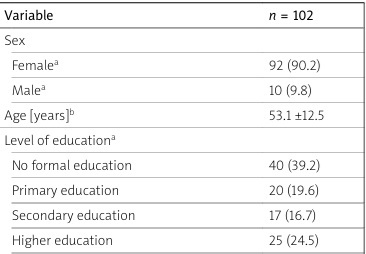
A total of 102 patients with RA agreed to participate in the study. The sociodemographic and clinical characteristics of these patients are presented in Table I. The mean age was 53.1 ±12.5 years, and 90.2% of participants were women. The illiteracy rate was 39.2%.
Table I
Sociodemographic and clinical characteristics of the study population
| Variable | n = 102 |
|---|---|
| Sex | |
| Femalea | 92 (90.2) |
| Malea | 10 (9.8) |
| Age [years]b | 53.1 ±12.5 |
| Level of educationa | |
| No formal education | 40 (39.2) |
| Primary education | 20 (19.6) |
| Secondary education | 17 (16.7) |
| Higher education | 25 (24.5) |
| Area of residencea | |
| Urban | 86 (84.3) |
| Rural | 16 (15.7) |
| Disease duration [years]c | 14 [9.91–23.8] |
| Current treatmenta | |
| NSAIDs | 12 (11.8) |
| GCs | 68 (66.7) |
| MTX | 71 (69.6) |
| Leflunomide | 15 (14.7) |
| Sulfasalazine | 10 (9.8) |
| bDMARDs | 39 (28.2) |
| Anti-CD20 | 14 (13.7) |
| Anti-TNF | 23 (22) |
| Anti-IL-6 | 2 (2) |
The median duration of RA was 14 years (9.91–23.8), with a median duration of MTX use of 4 years (2–10). The median time between MTX prescription and treatment initiation was 2 weeks (0–24).
Methotrexate was mainly administered as injections to be prepared and tablets, in 58.8% and 29.4% of cases, respectively. Self-injection was practiced by 23.8% of patients. Concomitant folic acid supplementation was prescribed in 78.4% of patients. The main sources of information about MTX were rheumatologists, cited by 93.1% of patients, followed by internet sources, cited by 25.5% of patients.
The fear scale showed excellent internal consistency (Cronbach’s α = 0.895; McDonald’s ω = 0.898), with corrected item–total correlations above 0.30. The median overall score for fear of MTX was 2.58 (1.93–3.33), indicating an overall moderate level of fear: 46.1% of patients had a low level of fear, 30.4% had a moderate level, and 23.5% had a high level. Detailed descriptive results for each item are shown in Table II.
Table II
Methotrexate patients’ fears
Beliefs about MTX (Table III). The mean BMQ-Necessity score was 15.0 ±5.04, and the mean BMQ-Concerns score was 15.9 ±6.37. Long-term adverse effects were the main source of concern, reported by 58.8% of patients.
Table III
Beliefs of Moroccan patients with inflammatory rheumatic diseases regarding methotrexate
The BMQ necessity–concerns differential (“BMQ differential”) had a median of 1 [from –3 to 4]; 51% of patients had a BMQ necessity–concerns differential > 0.
In the univariate and multivariate analyses (Table IV), the BMQ differential was significantly associated with disease duration (β = –0.12; 95% CI: from –0.23 to –0.02) and the use of the internet as a source of medical information (β =–2.66; 95% CI: from –5.06 to –0.27).
Table IV
Univariate and multivariate analyses for the BMQ necessity–concerns differential
Discussion
In our study, 51% of patients with RA had a positive BMQ differential, indicating that they recognized the need for MTX to address their conditions. This suggests an overall favorable attitude towards this treatment. More than half of the respondents (54%) reported that their treatment “protected them from disease progression”. The main concern was long-term side effects, cited by 58.8% of patients. Digestive and hepatic effects were reported by 65.7% and 62.7% of patients, respectively. These results are consistent with those of previous studies, which reported that gastrointestinal toxicity (nausea, abdominal pain and diarrhea) and hepatotoxicity are the most feared MTX side effects, even among patients who have not experienced them directly [7, 10, 15].
Despite the existence of considerable clinical evidence suggesting a favorable hepatic safety profile for MTX in the treatment of RA, one of the most frequently reported concerns among patients remains hepatic toxicity. Recent data from a cross-sectional study demonstrated no association between MTX exposure and non-alcoholic fatty liver disease or liver fibrosis. Metabolic factors appear to be the main determinants of liver damage [16]. Similar results were reported in a cohort of patients receiving long-term MTX, where an increased incidence of liver fibrosis was not associated with the cumulative dose received [17].
Literature demonstrates that RA patients frequently express concerns about adverse effects, drug toxicity, and long-term consequences, including fear of disability or disease progression. Palominos et al. reported that fears relating to pharmacological treatment were present in half of the analyzed studies, while fears relating to disability and disease progression were present in 28% of cases [18]. Hayden et al. [10] found that patients on MTX oscillated between necessity and concern, and that their beliefs may change over the course of their treatment. These findings confirm that such fears are significant determinants of patient compliance and highlight the importance of recognizing and addressing them in clinical practice.
Our analyses revealed that both disease duration and the use of the internet as a source of information were independently associated with patients’ beliefs about MTX. A longer duration of RA was significantly associated with a lower total BMQ score, reflecting a reduced perception of treatment necessity and increased concerns about it.
While previous studies have reported that prolonged disease duration leads to a stronger belief in the need for treatment [19, 20], our results suggest the opposite in this context. This discrepancy could be explained by treatment fatigue, resulting from the cumulative impact of medication experiences, adverse effects, and treatment failures, which gradually lead to a loss of confidence and heightened concerns. This finding emphasizes the evolving and contextual nature of medication beliefs, as demonstrated in several studies [10, 19].
Using the internet as a source of information also influenced beliefs about MTX. Patients who reported consulting online sources had a significantly lower total BMQ score, reflecting an increased perception of risks relative to the necessity of treatment. These findings are in line with those of Otón et al. [21], who observed that most patients treated with MTX actively seek information online, but are rarely referred by their rheumatologist to reliable online resources, resulting in unsatisfied information needs and potentially confusing content. In Morocco, internet access is expanding rapidly, but the quality, reliability and readability of the available medical content vary greatly.
International data [22–24] confirm that the impact of the internet on therapeutic beliefs is ambivalent; while it can promote patient autonomy and active participation in care, it can also cause confusion, concern, or even refusal of treatment when information is not correctly interpreted or contextualized. These findings emphasize the importance of integrating eHealth literacy into the doctor–patient relationship. Patients should be directed towards certified platforms and content, and the reliability of online sources should be systematically addressed during consultations. This reduces the impact of misinformation and builds confidence in treatments, particularly in settings where health literacy is limited.
Univariate analysis revealed that education level and source of medical information were independently associated with beliefs about MTX. Patients with a higher education had lower total BMQ scores than those with no education, suggesting a more critical assessment of potential risks relative to perceived necessity. This finding is consistent with the results of a study conducted in the United Kingdom by Kumar et al. [25], which showed that lower levels of education were associated with more favorable beliefs about medications. Conversely, receiving information directly from the rheumatologist was associated with higher BMQ scores, reflecting a stronger belief in the necessity of treatment. However, this association was no longer significant in the multivariate analysis. These results highlight the importance of therapeutic education and structured medical communication based on a trusting relationship to support MTX adherence [26, 27].
Our results underline the complexity of beliefs about MTX. These are not only determined by clinical factors, but also by the social and cultural context. Patients living in rural areas had higher BMQ scores than those in urban areas, suggesting a stronger belief in the need for treatment. Conversely, urban patients, who were exposed to more sources of information, expressed more concerns. These observations are consistent with previous reports showing that cultural and contextual differences can strongly influence patients’ perceptions of medications [20, 28].
Study limitations
However, we should note some limitations of our study. Firstly, the small sample size, resulting from treatment discontinuations observed during the inclusion period, reduces statistical power and may limit the scope of the conclusions. In addition, the cross-sectional design of the study does not enable us to establish a causal link between the variables. Beliefs may evolve over time depending on disease progression and therapeutic experiences. Finally, conducting the study in a single Moroccan center may limit the generalisability of the results.
Conclusions
Our results show that MTX is generally perceived as necessary by patients with RA, despite fears associated with its use. The duration of the disease and internet use were associated with a “concerns > necessity” balance, highlighting the need for therapeutic education interventions adapted to the cultural context, as well as guidance towards reliable digital sources, to optimize adherence and clinical outcomes.