Current issue
Archive
Online first
About the Journal
Editorial Office
Editorial Board
Publisher
Editorial Policies
Ethical standards and procedures
Abstracting and indexing
Reviewers
Honorary Reviewers
Subscription
Contact
Most read articles
Instructions for authors
Article processing charge (APC)
Books and Events
Books
Events


ORIGINAL PAPER
Skeletal muscle status in patients with rheumatoid arthritis and its association with disease course
1
Department of Internal Medicine No. 2, National Pirogov Memorial Medical University, Vinnytsya, Ukraine
2
Department of Propedeutics of Internal Medicine, National Pirogov Memorial Medical University, Vinnytsya, Ukraine
Submission date: 2025-10-17
Final revision date: 2025-12-31
Acceptance date: 2026-02-02
Publication date: 2026-11-06
Corresponding author
Anna Poberezhets
Department of Internal Medicine No. 2, National Pirogov Memorial Medical University, Vinnytsya, Ukraine
Department of Internal Medicine No. 2, National Pirogov Memorial Medical University, Vinnytsya, Ukraine
Reumatologia 2026;64(5):386-394
KEYWORDS
TOPICS
ABSTRACT
Objectives:
Rheumatoid arthritis (RA) is a chronic autoimmune disease that leads to rapid disability. Increased systemic inflammation, limited physical activity, and frequent glucocorticoid use in patients with RA can lead to sarcopenia, which is the loss of muscle strength, mass, and sometimes physical performance, thereby worsening the course of the primary disease, reducing productivity, and lowering quality of life. The aim of our study was to assess the state of skeletal muscle in patients with RA and evaluate its relationship with the course of the disease.
Material and methods:
The study included 120 patients with RA (women and men) and 30 control group participants. Skeletal muscle status was evaluated according to the criteria of the European Working Group on Sarcopenia in Older People (EWGSOP), 2019. Skeletal muscle status was determined using dual-energy X-ray absorptiometry. RA activity was evaluated using the DAS28, CDAI, and SDAI indices. Laboratory studies included determining the level of ESR and CRP.
Results:
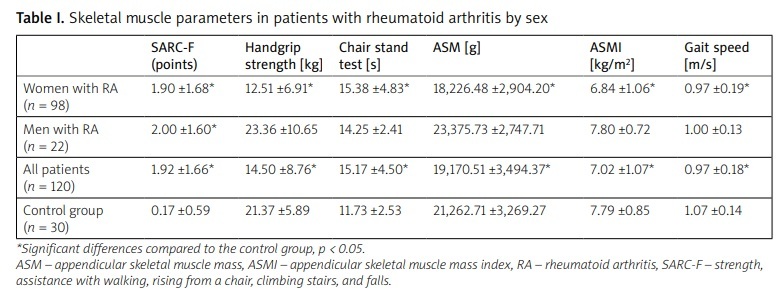
The state of skeletal muscle was significantly worse in RA patients than in the control group. The most significant correlations were found between the risk of developing sarcopenia according to SARC-F, hand grip strength, chair stand test and appendicular skeletal mass (ASM) on the one hand, and DAS28 values on the other (r=0.57, r=-0.35, r=0.44, r=-0. 37, respectively, p<0.05). In contrast, a lower ASM index (ASMI) was significantly associated with higher CRP levels (r=-0.37, p<0.05) and was not associated with patients age or disease duration.
Conclusions:
The decrease in hand grip strength and skeletal muscle mass is not associated to the age of patients and disease duration. Instead, the values of all skeletal muscle parameters are closely associated with disease activity and the radiographic stage of RA.
REFERENCES (30)
1.
Cano-García L, Manrique-Arija S, Domínguez-Quesada C, et al. Sarcopenia and nutrition in elderly rheumatoid arthritis patients: a cross-sectional study to determine prevalence and risk factors. Nutrients 2023; 15: 2440, DOI: 10.3390/nu15112440.
2.
An HJ, Tizaoui K, Terrazzino S, et al. Sarcopenia in autoimmune and rheumatic diseases: a comprehensive review. Int J Mol Sci 2020; 21: 5678, DOI: 10.3390/ijms21165678.
3.
Su Q, Jin C, Yang Y, et al. Association between autoimmune diseases and sarcopenia: a two-sample Mendelian randomization study. Clin Epidemiol 2023; 15: 901–910, DOI: 10.2147/CLEP.S416778.
4.
Li W, Moylan JS, Chambers MA, et al. Interleukin-1 stimulates catabolism in C2C12 myotubes. Am J Physiol Cell Physiol 2009; 297: C706–C714, DOI: 10.1152/ajpcell.00626.2008.
5.
Mochizuki T, Yano K, Ikari K, Okazaki K. Sarcopenia-associated factors in Japanese patients with rheumatoid arthritis: a cross-sectional study. Geriatr Gerontol Int 2019; 19: 907–912, DOI: 10.1111/ggi.13747.
6.
Dao T, Green AE, Kim YA, et al. Sarcopenia and muscle aging: a brief overview. Endocrinol Metab (Seoul) 2020; 35: 716–732, DOI: 10.3803/EnM.2020.405.
7.
Hasegawa E, Ito S, Kurosawa Y, et al. The efficacy of biological disease-modifying antirheumatic drugs on sarcopenia in patients with rheumatoid arthritis. Intern Med 2023; 62: 373–379, DOI: 10.2169/internalmedicine.9600-22.
8.
Giles JT, Ling SM, Ferrucci L, et al. Abnormal body composition phenotypes in older rheumatoid arthritis patients: association with disease characteristics and pharmacotherapies. Arthritis Rheum 2008; 59: 807–815, DOI: 10.1002/art.23719.
9.
Li TH, Chang YS, Liu CW, et al. The prevalence and risk factors of sarcopenia in rheumatoid arthritis patients: a systematic review and meta-regression analysis. Semin Arthritis Rheum 2021; 51: 236–245, DOI: 10.1016/j.semarthrit.2020.10.002.
10.
Torii M, Itaya T, Minamino H, et al. Management of sarcopenia in patients with rheumatoid arthritis. Mod Rheumatol 2023; 33: 435–440, DOI: 10.1093/mr/roac095.
11.
Martín AI, Priego T, López-Calderón A. Hormones and muscle atrophy. Adv Exp Med Biol 2018; 1088: 103–120, DOI: 10.1007/ 978-981-13-1435-3_9.
12.
Aletaha D, Neogi T, Silman AJ, et al. 2010 rheumatoid arthritis classification criteria: an American College of Rheumatology/ European League Against Rheumatism collaborative initiative. Ann Rheum Dis 2010; 69: 1580–1588, DOI: 10.1136/ard.2010.138461.
13.
Cruz-Jentoft AJ, Bahat G, Bauer J, et al. Sarcopenia: revised European consensus on definition and diagnosis. Age Ageing 2019; 48: 16–31, DOI: 10.1093/ageing/afy169.
14.
Doğan SC, Hizmetli S, Hayta E, et al. Sarcopenia in women with rheumatoid arthritis. Eur J Rheumatol 2015; 2: 57–61, DOI: 10.5152/eurjrheum.2015.0038.
15.
Mochizuki T, Yano K, Ikari K, Okazaki K. Effectiveness of locomotion training in patients with rheumatoid arthritis: a prospective clinical trial. J Phys Ther Sci 2023; 35: 810–816, DOI: 10.1589/jpts.35.810.
16.
Lozada-Mellado M, Llorente L, Hinojosa-Azaola A, et al. Inflammatory profile in patients with rheumatoid arthritis and sarcopenia. Clin Rheumatol 2024; 43: 1865–1870, DOI: 10.1007/s10067-024-06974-9.
17.
Alkan Melikoğlu M. Presarcopenia and its impact on disability in female patients with rheumatoid arthritis. Arch Rheumatol 2017; 32: 53–59, DOI: 10.5606/ArchRheumatol.2017.6078.
18.
Beenakker KGM, Ling CH, Meskers CGM, et al. Patterns of muscle strength loss with age in the general population and patients with a chronic inflammatory state. Ageing Res Rev 2010; 9: 431–436, DOI: 10.1016/j.arr.2010.05.005.
19.
Torii M, Hashimoto M, Hanai A, et al. Prevalence and factors associated with sarcopenia in patients with rheumatoid arthritis. Mod Rheumatol 2019; 29: 589–595, DOI: 10.1080/ 14397595. 2018.1510565.
20.
Kulyk M, Dzhus M. Assessment of sarcopenia in young patients with inflammatory arthritis: a cross-sectional study. Sci Rep 2025; 15: 8236, DOI: 10.1038/s41598-025-88939-9.
21.
Bertelle D, Bixio R, Bertoldo E, et al. POS0629 Prevalence and factors associated with sarcopenia in patients with rheumatoid arthritis. Ann Rheum Dis 2022; 81: 583, DOI: 10.1136/ annrheumdis-2022-eular.4552.
22.
Guzmán-Guzmán IP, Zaragoza-García O, Navarro-Zarza JE, et al. FRI0048 Sarcopenia and sarcopenic obesity are associated to glucocorticoid use and clinical and serological markers in rheumatoid arthritis. Ann Rheum Dis 2019; 78: 685–686, DOI: 10.1136/annrheumdis-2019-eular.7872.
23.
Müller R, Kull M, Põlluste K, et al. Factors associated with low lean mass in early rheumatoid arthritis: a cross-sectional study. Medicina (Kaunas) 2019; 55: 730, DOI: 10.3390/ medicina55110730.
24.
Tada M, Yamada Y, Mandai K, Hidaka N. THU0157 Relationship of matrix metalloprotease 3 titer and sarcopenia in patients with rheumatoid arthritis: data from the CHIKARA study. Ann Rheum Dis 2017; 76: 260, DOI: 10.1136/annrheumdis- 2017-eular.2334.
25.
Lin JZ, Wang YY, Liu PJ, et al. SAT0099 Sarcopenia is associated with joint damage in rheumatoid arthritis: a cross-sectional study. Ann Rheum Dis 2018; 77: 911–912, DOI: 10.1136/ annrheumdis-2018-eular.6085.
26.
Pardali EC, Klonizakis M, Goulis DG, et al. Sarcopenia in rheumatic diseases: a hidden issue of concern. Diseases 2025; 13: 134, DOI: 10.3390/diseases13050134.
27.
Munro R, Capell H. Prevalence of low body mass in rheumatoid arthritis: association with the acute phase response. Ann Rheum Dis 1997; 56: 326–329, DOI: 10.1136/ard.56.5.326.
28.
van Atteveld VA, Van Ancum JM, Reijnierse EM, et al. Erythrocyte sedimentation rate and albumin as markers of inflammation are associated with measures of sarcopenia: a cross-sectional study. BMC Geriatr 2019; 19: 233, DOI: 10.1186/s12877-019-1253-5.
29.
Park DJ, Kang JH, Xu H, et al. THU0152 Sarcopenia is associated with persistent disease activity during follow-up of rheumatoid arthritis. Ann Rheum Dis 2019; 78: 349, DOI: 10.1136/annrheumdis-2019-eular.3412.
30.
Ngeuleu A, Allali F, Medrare L, et al. Sarcopenia in rheumatoid arthritis: prevalence, influence of disease activity and associated factors. Rheumatol Int 2017; 37: 1015–1020, DOI: 10.1007/s00296-017-3665-x.
Copyright: © Narodowy Instytut Geriatrii, Reumatologii i Rehabilitacji w Warszawie. This is an Open Access journal, all articles are distributed under the terms of the Creative Commons Attribution-NonCommercial-ShareAlike 4.0 International (CC BY-NC-SA 4.0) License (https://creativecommons.org/licenses/by-nc-sa/4.0/), allowing third parties to copy and redistribute the material in any medium or format and to remix, transform, and build upon the material, provided the original work is properly cited and states its license.
Share
RELATED ARTICLE
| eISSN: | 2084-9834 |
| ISSN: | 0034-6233 |

We process personal data collected when visiting the website. The function of obtaining information about users and their behavior is carried out by voluntarily entered information in forms and saving cookies in end devices. Data, including cookies, are used to provide services, improve the user experience and to analyze the traffic in accordance with the Privacy policy. Data are also collected and processed by Google Analytics tool (more).
You can change cookies settings in your browser. Restricted use of cookies in the browser configuration may affect some functionalities of the website.
You can change cookies settings in your browser. Restricted use of cookies in the browser configuration may affect some functionalities of the website.