
Introduction
Clinical trials are essential for evidence-based practice guidelines in rheumatology and physical medicine and rehabilitation (PMR). Since both rapidly developing disciplines address chronic, complex, and variable diseases, clinical trial planning requires testable hypothesis formulation, study designing, and reflection on ethical and clinical outcomes [1].
Editorials highlight current developments and offer objective, evidence-based expert opinions [2]. This editorial aims to highlight the importance of clinical trials, outline best practices for designing and reporting, discuss quality evaluation, and propose strategies for boosting implications at the societal level.
Evidence shaping guidelines
Randomized controlled trials (RCTs) provide the most unbiased assessment of clinical interventions for contributing to the highest level of evidence. In rheumatology, RCTs are the primary source for evaluating drug therapies in terms of their effects on disease activity, radiographic progression, and comorbidities. In PMR, RCTs are designed to assess interventions ranging from exercise therapies to injection techniques and multidisciplinary rehabilitation programs. The European Alliance of Associations for Rheumatology (EULAR) and American College of Rheumatology (ACR) practice guidelines, as well as the Outcome Measures in Rheumatology (OMERACT) core outcome sets, are based on a synthesis of these trials using the GRADE approach. Trial design weaknesses may directly influence the strength of related practice guidelines. Notably, the superiority of RCTs is limited in PMR because randomization is often not feasible and at times unethical. Practice guideline developers should explicitly address these design limitations when synthesizing evidence.
Registration and reporting
Prospective registration of trials is an essential practice that upholds research integrity and prevents redundancies in the field. The International Committee of Medical Journal Editors (ICMJE) generally expects registration in a registry associated with ClinicalTrials.gov or the World Health Organization International Clinical Trials Registry Platform (WHO ICTRP) network prior to the enrollment of subjects as a precondition for publication in member journals; ethics approvals without trial registration are sufficient [3]. In 2025, a major update was introduced: the CONSORT guidelines for reporting completed trials and the SPIRIT guidelines for protocols were revised collaboratively by a working group and published in several leading medical journals [4, 5]. The revised guidelines place greater emphasis on harm assessment, comprehensive description of interventions, and patient and public involvement. This is particularly important for PMR studies, where a precise definition of intervention components, including dose, frequency, duration, and practitioner qualifications, is necessary for reproducibility. The Template for Intervention Description and Replication (TIDieR) extension serves as a complementary tool to CONSORT for specifying non- pharmacological interventions. Survey-based studies, often filling gaps in the fields, should also provide details of respondent awareness and attitudes toward interventions in rheumatology and PMR, with openly displaying questionnaires as a prerequisite for successful publication [6].
Quality assessment
Publication alone does not guarantee the reliability of a trial. The Cochrane RoB 2 tool identifies five domains where bias may occur, categorizing them as “high risk of bias,” “some concerns,” or “low risk of bias.” The domains addressing deviations from intended interventions and measurement of the outcome require particular scrutiny in studies where blinding is challenging [7]. At the level of evidence synthesis, the GRADE approach evaluates the certainty of a body of evidence based on risk of bias, inconsistency, indirectness, imprecision, and publication bias. In rheumatology, the OMERACT filter 2.0 stipulates that outcome measures must demonstrate “truth,” “discrimination,” and “feasibility” to be suitable for clinical trials [8]. For PMR, physiotherapy-specific instruments such as the PEDro scale assess methodological quality using similar criteria. The evidence base of the peer-review process is yet another critical point, variably enforced by journals and thereby affecting the quality of publications, including clinical trials [9].
Hypothesis, design, and ethics
A valuable trial planning starts with formulating a hypothesis, derived from available evidence base, unusual clinical observations, and clinicians’ curiosity [10]. The choice of study design should align with the hypothesis: parallel group RCTs are optimal for assessing efficacy, pragmatic studies evaluate real-world applicability, adaptive designs assess flexibility, and N-of-1 studies – where different interventions are applied to the same patient in a randomized sequence over multiple periods – are particularly valuable for conditions such as chronic pain. Challenges in randomization, commonly encountered in PMR research, can be mitigated through evaluator blinding, the use of predefined objective outcome measures, and the implementation of an appropriate sham or control arm. Ethical implications should be envisaged at the hypothesis formulation stage [10]. Adherence to the revised principles of the Declaration of Helsinki (October 2024), independent ethics committee approval, informed consent, and a reasonable risk-benefit balance are essential. The evolving role and structure of ethics committees in this process are increasingly discussed [11]. The use of placebo in patients with active disease may be viewed as unethical. Each hypothesis should also establish its clinical applicability from the outset by defining clinically significant difference thresholds, to prevent confusion between statistical significance and clinical importance.
Citations and the societal impact
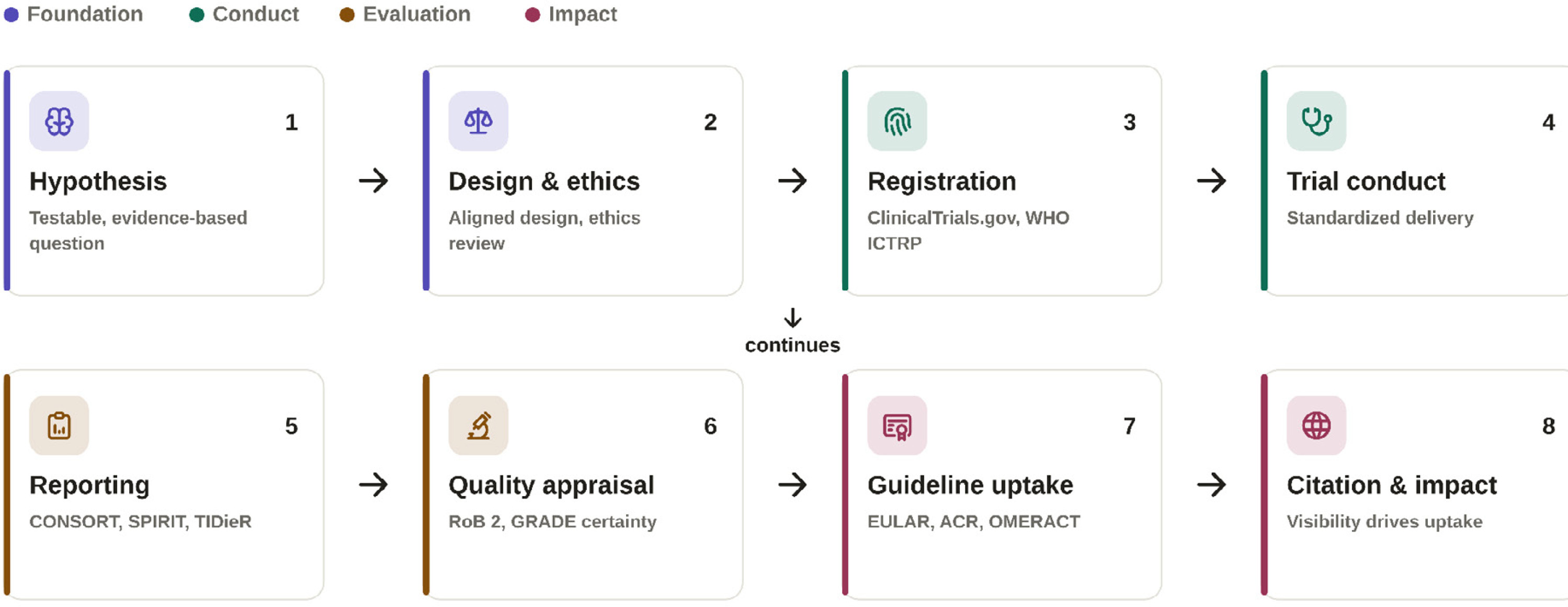
The adherence to available research reporting standards enhances inclusion of publications in systematic analyses and evidence synthesis, which may increase impact citation-wise. Nowadays, the dissemination of open-access publications confers a measurable citation advantage [12]. Social media platforms have emerged as impactful tools for increasing visibility, although its effect on long-term citation rates remains uncertain [13]. Altmetric indicators capture societal impact beyond traditional citations and add to global exposure of clinical trial reports and related practice guidelines. Engagement with the public via reputable social media platforms is increasingly recognized in the context of the adoption of research findings by both clinicians and decision-makers [14, 15]. Reporting quality, accessibility, open data sharing, and societal impact represent interdependent and complementary components, though none are sufficient in isolation. The overall trajectory from hypothesis formulation to societal impact is summarized in Figure 1.
Conclusions
In rheumatology and PMR, clinical trials are fundamental to the process that transforms a hypothesis into clinically applicable guideline recommendations. Evidence-based hypotheses formulation, appropriately chosen trial design, ethical conduct, and transparent registration and reporting are mutually dependent. Any deficiency in these areas diminishes the strength of the evidence that contributes to practice guidelines. Addressing these interdependent elements comprehensively enhances both the value of individual trial reports and the credibility of evidence-based medicine. Researchers, editors, and reviewers share the responsibility of enforcing trial reporting standards and results in their daily practice.