Bieżący numer
Archiwum
Online first
O czasopiśmie
Redakcja
Rada Naukowa
Wydawca
Standardy etyczne i procedury
Bazy indeksacyjne
Recenzenci
Recenzenci Honorowi
Prenumerata
Kontakt
Najczęściej czytane artykuły
Dla autorów
Opłata za przetwarzanie artykułu (APC)
Książki i Konferencje
Książki
Konferencje
SARS CoV-2/COVID-19


PRACA ORYGINALNA
Rheumatologists’ attitudes to smoking cessation support: a pilot study

1
Rheumaticus Student Research Group, Medical University of Warsaw, Poland
2
Health Data Science Student Research Group, Department of Epidemiology and Biostatistics, Medical University of Warsaw, Poland
3
Department of Epidemiology and Biostatistics, Medical University of Warsaw, Poland
Data nadesłania: 09-06-2026
Data ostatniej rewizji: 20-06-2026
Data akceptacji: 22-06-2026
Data publikacji online: 30-06-2026
Autor do korespondencji
Paweł Piluch
Rheumaticus Student Research Group; Medical University of Warsaw; Warszawa; Poland Health Data Science Student Research Group; Department of Epidemiology and Biostatistics; Medical University of Warsaw; Warszawa; Poland
Rheumaticus Student Research Group; Medical University of Warsaw; Warszawa; Poland Health Data Science Student Research Group; Department of Epidemiology and Biostatistics; Medical University of Warsaw; Warszawa; Poland
SŁOWA KLUCZOWE
DZIEDZINY
STRESZCZENIE
Objectives:
Smoking is particularly harmful to patients with rheumatic diseases, hence rheumatologists’ essential role is to actively support them in quitting. The rise in smoking rates in Poland calls for the appropriate measures. The rationale for this study was to assess feasibility and provide initial understanding as a framework for a future study on the factors determining rheumatologists’ attitudes towards assisting patients to cease smoking.
Material and methods:
This cross-sectional survey was conducted among physician staff in the rheumatology wards and outpatient clinic of a national reference centre in Poland. The questionnaire addressed attitudes and practices regarding smoking cessation support, with reference to the respondents’ own approach and their perception of other rheumatologists.
Results:
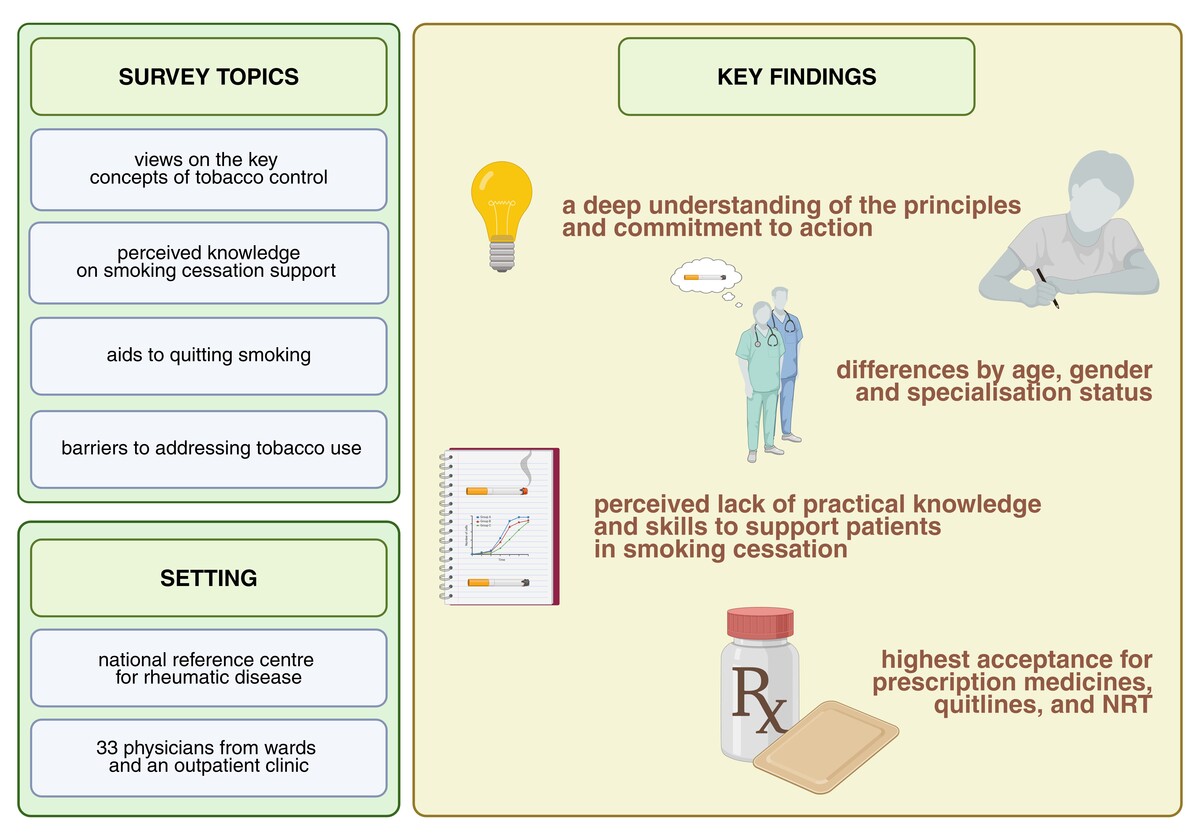
The study obtained 33 questionnaires. All respondents considered nicotine addiction and its management important and to be addressed in clinical practice. Physicians only consider the harm caused by smoking to be an area in which they have sufficient knowledge to provide professional counseling to patients, as opposed to the practical aspects of support. Prescription medication, psychological support and nicotine replacement therapy are the declared preferred methods to advise, whilst the proportion of doctors who actually make these recommendations to their patients did not vary significantly from 50%. The main obstacles identified when encouraging patients to give up smoking were a lack of time to address the issue and patients’ resistance. In the study significant differences depending on the respondents’ age and gender were observed.
Conclusions:
Physicians are aware of key theoretical concepts and importance of supporting patients in their efforts to stop smoking, but lack practical knowledge and skills required to act effectively. Significant differences depending on the respondents’ age and gender justify a stratified analyses in the intended study. The findings confirmed the feasibility and relevance of undertaking a full-scale study with stratified analyses based on at least age and gender of the physicians.
Smoking is particularly harmful to patients with rheumatic diseases, hence rheumatologists’ essential role is to actively support them in quitting. The rise in smoking rates in Poland calls for the appropriate measures. The rationale for this study was to assess feasibility and provide initial understanding as a framework for a future study on the factors determining rheumatologists’ attitudes towards assisting patients to cease smoking.
Material and methods:
This cross-sectional survey was conducted among physician staff in the rheumatology wards and outpatient clinic of a national reference centre in Poland. The questionnaire addressed attitudes and practices regarding smoking cessation support, with reference to the respondents’ own approach and their perception of other rheumatologists.
Results:
The study obtained 33 questionnaires. All respondents considered nicotine addiction and its management important and to be addressed in clinical practice. Physicians only consider the harm caused by smoking to be an area in which they have sufficient knowledge to provide professional counseling to patients, as opposed to the practical aspects of support. Prescription medication, psychological support and nicotine replacement therapy are the declared preferred methods to advise, whilst the proportion of doctors who actually make these recommendations to their patients did not vary significantly from 50%. The main obstacles identified when encouraging patients to give up smoking were a lack of time to address the issue and patients’ resistance. In the study significant differences depending on the respondents’ age and gender were observed.
Conclusions:
Physicians are aware of key theoretical concepts and importance of supporting patients in their efforts to stop smoking, but lack practical knowledge and skills required to act effectively. Significant differences depending on the respondents’ age and gender justify a stratified analyses in the intended study. The findings confirmed the feasibility and relevance of undertaking a full-scale study with stratified analyses based on at least age and gender of the physicians.
REFERENCJE (23)
1.
Zatoński WA, Przewoźniak K, Bieńkowski M, Łanda K. Unexpected sharp increase in smoking in Poland. Did the Polish tobacco control strategy collapse? J Health Inequal 2026; 11: 101–105, DOI: 10.5114/jhi.2025.158338.
2.
Wilkinson TM. The Ethics of Public Health Paternalism. Oxford University Press, Oxford 2025.
3.
Doll R, Peto R, Boreham J, Sutherland I. Mortality in relation to smoking: 50 years’ observations on male British doctors. BMJ 2004; 328: 1519, DOI: 10.1136/bmj.38142.554479.AE.
4.
Two decades of the implementation of the WHO Framework Convention on Tobacco Control in the European Union: progress, challenges and the road ahead. WHO Regional Office for Europe, Copenhagen 2025.
5.
The Council of Ministers of the Republic of Poland. Rozporządzenie Rady Ministrów z dnia 4 sierpnia 2016 r. w sprawie Narodowego Programu Zdrowia na lata 2016–2020. Journal of Laws, Warsaw 2016.
6.
England BR, Smith BJ, Baker NA, et al. 2022 American College of Rheumatology Guideline for Exercise, Rehabilitation, Diet, and Additional Integrative Interventions for Rheumatoid Arthritis. Arthritis Rheumatol 2023; 75: 1299–1311, DOI: 10.1002/art.42507.
7.
Streck JM, Rigotti NA, Livingstone-Banks J, et al. Interventions for smoking cessation in hospitalised patients. Cochrane Database Syst Rev 2024; 5: CD001837, DOI: 10.1002/14651858.CD001837.pub4.
8.
The Oxford Handbook of Health Communication, Behavior Change, and Treatment Adherence. Oxford University Press, Oxford 2013.
9.
Naea De Valle M, Norman P. Causal Attributions, Health Locus of Control Beliefs and Lifestyle Changes Among Pre-Operative Coronary Patients. Psychology Health 1992; 7: 201–211, DOI: 10.1080/08870449208520021.
10.
Voigt K. Smoking and Social Justice. Public Health Ethics 2010; 3: 91–106, DOI: 10.1093/phe/phq006.
11.
Stead LF, Bergson G, Lancaster T. Physician advice for smoking cessation. Cochrane Database Syst Rev 2008; 2: CD000165, DOI: 10.1002/14651858.CD000165.pub3.
12.
Stead LF, Perera R, Bullen C, Mant D, Lancaster T. Nicotine replacement therapy for smoking cessation. Cochrane Database Syst Rev 2008; 1: CD000146, DOI: 10.1002/14651858.CD000146.pub3.
13.
Stead LF, Perera R, Lancaster T. A systematic review of interventions for smokers who contact quitlines. Tobacco Control 2007; 16 (Suppl): i3–i8.
14.
Voigt K. Tobacco as a Matter of Public Health: Ethical Issues. In: Mastroianni AC, Kahn JP, Kass NE (eds.). The Oxford Handbook of Public Health Ethics. Oxford University Press, Oxford 2019.
15.
Lopez-Olivo MA, Kachira JJ, Madramootoo S, et al. Physician Views and Attitudes Regarding Tobacco-Cessation Strategies for Patients with Rheumatoid Arthritis. Arthritis Care Res (Hoboken) 2025; 77: 767–776, DOI: 10.1002/acr.25500.
16.
Konopko M, Bieńkowski P, Wojnar M, et al. Real-life anti-smoking practices among Polish neurologists. Post Psychiatr Neurol 2021; 30: 162–169, DOI: 10.5114/ppn.2021.110680.
17.
Wojcik JV. Social learning predictors of the avoidance of smoking relapse. Addict Behav 1988; 13: 177–180, DOI: 10.1016/0306-4603(88)90008-1.
18.
Puljević C, Stjepanović D, Meciar I, et al. Systematic review and meta-analyses of cytisine to support tobacco cessation. Addiction 2024; 119: 1713–1725, DOI: 10.1111/add.16592.
19.
Chen DTH, Grigg J, Filippidis FT. European Respiratory Society statement on novel nicotine and tobacco products, their role in tobacco control and “harm reduction”. Eur Respir J 2024; 63: 2301808, DOI: 10.1183/13993003.01808-2023.
20.
van der Eijk Y. Ethics of tobacco harm reduction from a liberal perspective. J Med Ethics 2016; 42: 273–277, DOI: 10.1136/medethics-2015-102974.
21.
Lindson N, Theodoulou A, Ordóñez-Mena JM, et al. Pharmacological and electronic cigarette interventions for smoking cessation in adults: component network meta-analyses. Cochrane Database Syst Rev 2023; 9: CD015226, DOI: 10.1002/14651858.CD015226.pub2.
22.
Naranjo A, Khan NA, Cutolo M, et al. Smoking cessation advice by rheumatologists: results of an international survey. Rheumatology 2014; 53: 1825–1829, DOI: 10.1093/rheumatology/keu213.
23.
Laugesen M, Rasmussen M, Christensen R, et al. Smoking Cessation Rates among Patients with Rheumatoid Arthritis and Osteoarthritis Following the ‘Gold Standard Programme’ (GSP): a Prospective Analysis from the Danish Smoking Cessation Database. Int J Environ Res Public Health 2022; 19: 5815, DOI: 10.3390/ijerph19105815.
Copyright: © Narodowy Instytut Geriatrii, Reumatologii i Rehabilitacji w Warszawie. This is an Open Access journal, all articles are distributed under the terms of the Creative Commons Attribution-NonCommercial-ShareAlike 4.0 International (CC BY-NC-SA 4.0) License (https://creativecommons.org/licenses/by-nc-sa/4.0/), allowing third parties to copy and redistribute the material in any medium or format and to remix, transform, and build upon the material, provided the original work is properly cited and states its license.
Udostępnij
| eISSN: | 2084-9834 |
| ISSN: | 0034-6233 |

Przetwarzamy dane osobowe zbierane podczas odwiedzania serwisu. Realizacja funkcji pozyskiwania informacji o użytkownikach i ich zachowaniu odbywa się poprzez dobrowolnie wprowadzone w formularzach informacje oraz zapisywanie w urządzeniach końcowych plików cookies (tzw. ciasteczka). Dane, w tym pliki cookies, wykorzystywane są w celu realizacji usług, zapewnienia wygodnego korzystania ze strony oraz w celu monitorowania ruchu zgodnie z Polityką prywatności. Dane są także zbierane i przetwarzane przez narzędzie Google Analytics (więcej).
Możesz zmienić ustawienia cookies w swojej przeglądarce. Ograniczenie stosowania plików cookies w konfiguracji przeglądarki może wpłynąć na niektóre funkcjonalności dostępne na stronie.
Możesz zmienić ustawienia cookies w swojej przeglądarce. Ograniczenie stosowania plików cookies w konfiguracji przeglądarki może wpłynąć na niektóre funkcjonalności dostępne na stronie.