Introduction
Fibromyalgia (FM) is a central pain regulation disorder, characterized by chronic generalized musculoskeletal pain, stiffness, and tenderness [1]. Fibromyalgia is often accompanied by somatic and psychological symptoms such as chronic fatigue, sleep disturbances, anxiety, and depression [2]. The etiology of FM is unknown, with no evidence of musculoskeletal inflammation. Patients with FM experience central sensitization in the brain, resulting in lower nociceptive tolerances that induce hyperalgesia and increase pain catastrophizing [3]. Fibromyalgia impacts approximately 5% of the population worldwide. It predominantly affects women, who represent up to 90% of the cases [4]. Moreover, FM symptoms, particularly generalized pain, often present more severely in women than in men [5]. Fibromyalgia imposes not only physical but also economic burdens due to its debilitating pain, which hinders the ability to engage in daily activities and significantly diminishes both the quality of life (QoL) and work productivity [6]. Furthermore, managing the chronic widespread pain associated with FM may be challenging in clinical practice [7].
Currently, the treatment for FM is a multidisciplinary approach, combining pharmacological therapies with physical exercise and behavioral therapy [8]. Recent guidelines have recommended limited medications. The Food and Drug Administration has only approved three drugs for FM treatment: pregabalin, duloxetine, and milnacipran. However, pharmacological intervention alone provides limited benefit, with long-term side effects such as dizziness, somnolence, headache, weight gain, and edema [9, 10]. Research has demonstrated that exercise is an essential complementary component in the management of functional impairment and pain associated with FM. Nevertheless, it is challenging to provide specific exercise interventions for FM due to the lack of a definitive mechanism and specific pain patterns [11]. Furthermore, the high levels of fatigue that individuals with FM experience may limit adherence to exercise-based interventions [12]. Consequently, there is a need for novel and efficient chronic pain interventions that impose minimal physical burden and are associated with few adverse effects.
Hyperbaric oxygen therapy (HBOT) has benefited several chronic pain conditions, reportedly including complex regional pain syndrome, trigeminal neuralgia, chronic headaches, and other pain conditions. Hyperbaric oxygen therapy is a non-invasive treatment modality that involves the intermittent inhalation of 100% oxygen (O2) within a chamber pressurized to greater than one atmosphere absolute (ATA) [13]. Hyperbaric oxygen therapy may alter the central pain regulation, which has been reported to positively improve FM symptoms. However, the recent update of European Alliance of Associations for Rheumatology (EULAR) recommendations do not recommend HBOT as a complementary treatment for FM due to insufficient evidence regarding its efficacy and safety [8]. Given its proposed analgesic effects and favorable tolerability profile, further investigation of its potential role in the management of FM is warranted.
This review aims to evaluate the efficacy and safety of HBOT as complementary care in managing FM syndrome, particularly in predominant female populations. Our goal is to determine whether HBOT can serve as a viable alternative by potentially offering a better safety profile without compromising on pain and symptom relief.
Material and methods
Search strategy
A comprehensive literature search was performed in three databases – PubMed/MEDLINE, Cochrane Library, and ScienceDirect – to identify studies published up to the year 2025. The literature search was conducted using the key words “hyperbaric oxygen therapy,” “fibromyalgia,” and “pain.” The key words were inputted into the advanced search function of the databases using the Boolean operator “AND” to identify records containing all concepts of interest. Synonyms and related terms were combined using the Boolean operator “OR” and adapted according to Medical Subject Headings (MeSH) where applicable. The final search strategy was: (“hyperbaric oxygenation” OR “hyperbaric oxygen therapy” OR “HBOT”) AND (“fibromyalgia” OR “FMS” OR “chronic pain”) AND (“pain” OR “visual analogue scale”). The protocol for this review was registered on 24th January 2025 with the International Prospective Register of Systematic Reviews (PROSPERO) with identification number CRD42025642759.
Eligibility criteria
The inclusion criteria for this systematic review were: 1) female patients diagnosed with FM; 2) treatment with HBOT administered in 90-minute sessions, in five sessions per week; 3) a control group receiving standard care (pharmacological therapy, physical exercise, or behavioral therapy) or no treatment as a comparison; and 4) reported outcomes including pain intensity and FM symptoms. Eligible studies were randomized controlled trials (RCTs), published in English, with full-text availability.
Exclusion criteria were: patients younger than 18 years, pregnant women, a history of brain injury or neurological complications, or a history of pre-existing conditions that may alter the results, such as chest pathology incompatible with HBOT and claustrophobia. Additionally, studies with inadequate data, such as a lack of baseline or follow-up numerical data (mean and standard deviation), reviews, case reports, editorials, and duplicates were excluded.
Study selection
This systematic review and meta-analysis was performed in accordance with the Preferred Reporting Items for Systematic Reviews and Meta-Analyses (PRISMA) guidelines [14]. Following completed searches, duplicates were removed using the Rayyan AI tool. Three authors working independently (ML, PL, and SG) screened the identified studies manually based on the title and abstract. An article was retrieved for full-text review if at least one reviewer considered it to fulfill the criteria and be within the scope of this systematic review. The reviewers then assessed the full-text articles for eligibility. Any disagreements were resolved by discussion with the fourth and fifth authors (AG and DM).
Quality assessment
The Cochrane risk of bias 2.0 tool (RoB-2) was used to evaluate all included RCTs. The tool is structured into five domains through which bias might be categorized as having a “low” or “high” risk of bias, or “some concerns” [15]. Each successfully retrieved full-text article was rated independently by three authors. Any disagreements were resolved by discussion with the fourth and fifth authors.
Data collection process and outcome measures
The studies that fulfilled the inclusion criteria were analyzed, and data were synthesized narratively. Data extracted from the studies were the following: the name of the main author, the year of publication, sample sizes, characteristics of the sample, inclusion and exclusion criteria, types of treatment given to control group, number of patients treated as control group, number of patients treated with HBOT, outcomes of the patients treated with control treatment, and outcomes of the patients treated with HBOT. The primary outcomes for this study were the effect of HBOT on pain relief measured with Visual Analogue Scale (VAS) and Widespread Pain Index (WPI)/tender point counts. The secondary outcomes anticipated were evaluation of FM symptom severity measured using the Fibromyalgia Impact Questionnaire (FIQ) and Symptom Severity Scale (SSS); QoL measured using the RAND 36-Item Short Form Health Survey (SF-36); and adverse events.
The statistical analyses were conducted using RevMan 5.4.1 software. Outcomes of the study were analyzed using mean difference (MD) as the measure of effect and 95% confidence intervals (CIs). A p-value of < 0.05 was considered statistically significant.
Results
Study selection
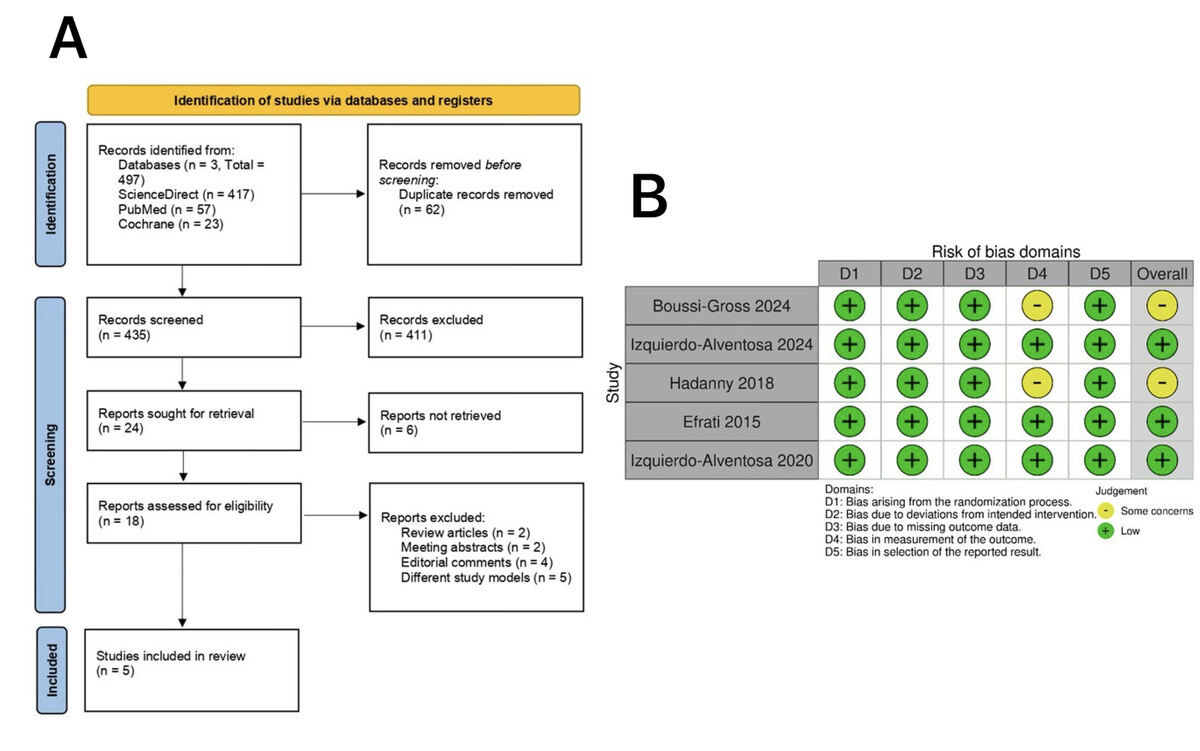
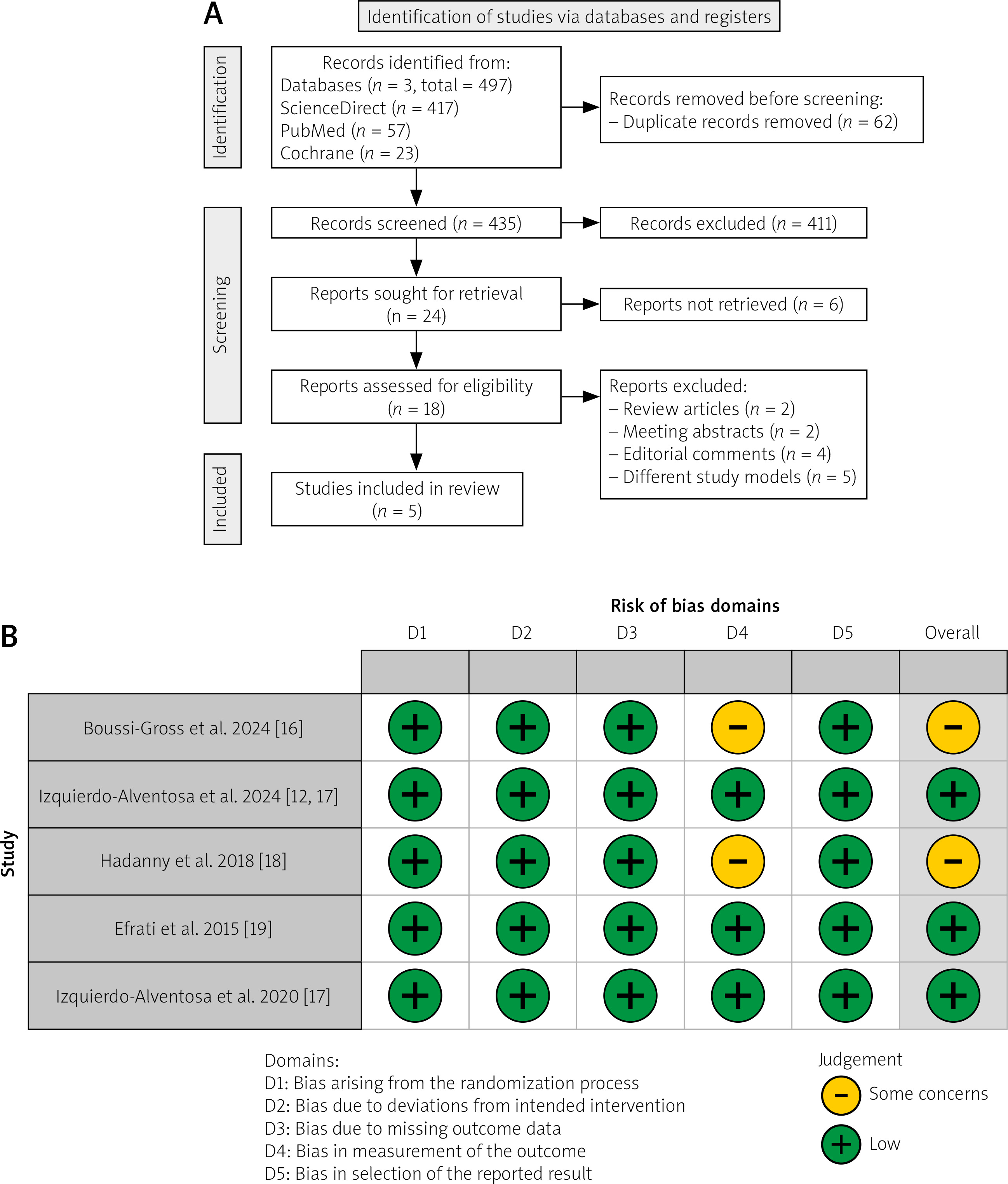
After conducting searches, a total of 497 studies were obtained from the 3 scientific databases: 417 studies from ScienceDirect, 57 studies from PubMed, and 23 studies from Cochrane Library. Sixty-two duplicate studies were detected using automation tools and were excluded, leaving 435 studies for screening. After screening the remaining studies, 411 studies were excluded for various reasons, such as not meeting the inclusion criteria, having irrelevant titles, having inappropriate abstracts that did not meet our criteria, and being in a language other than English. The final 24 studies were assessed for eligibility, and an attempt at full-text retrieval was successful for 18 studies. Of these 18 studies, 2 studies were excluded because they were review papers, 4 were excluded because they were commentaries, 2 were excluded because they were meeting abstracts, and 5 were excluded due to having different study models. Therefore, only 5 studies ultimately satisfied the inclusion criteria and were included in the systematic review. The study selection process of this review is shown in the PRISMA flowchart in Figure 1A.
Risk of bias assessment
The Cochrane RoB-2 instrument for RCTs was used to evaluate the quality of the studies in this review. A total of 5 randomized controlled studies were included in this meta-analysis and systematic review. The quality assessment results indicate that 2 studies were considered to have some concerns, while the other 3 studies have a low risk of bias. The risk of bias assessments conducted in this review are summarized in Figure 1B [12, 16–19].
Study characteristics
The study characteristics from the 5 studies included in this review are summarized in Table I [12, 16–19]. The total sample size for the 5 studies was 227 participants. All participants were female, which is consistent with the higher prevalence of FM in women. The mean follow-up duration was 2.4 months, ranging from 2 to 3 months.
Table I
Study characteristics
| Authors of the study, country | Sample size | Inclusion criteria | Exclusion criteria | Intervention | Control | Outcomes measured | Baseline demographics |
|---|---|---|---|---|---|---|---|
| BoussiGross et al. [16], 2024, Israel | Total: 52 HBOT group: 27 Control group: 25 | Female participants aged 18–45; diagnosed with FM by certified rheumatologist based on the updated 2016 diagnostic criteria; had a history of childhood sexual abuse and engaged in psychotherapy | Participants with a history of TBI, received pregabalin or duloxetine in the past year, had a history of major psychiatric disorder, and/or contraindicated to HBOT | HBOT protocol of inhalation 100% oxygen at 2.0 ATA, 60 daily sessions, 5 days/week, 90 minutes each | Pregabalin 75 mg or duloxetine 30 mg a day | FM functional impairment measured using FIQ, FM symptoms severity measured using tender point counts and SSS; quality of life measured using SF-36 questionnaire pre-post intervention; follow-up 3 months | Female participants with mean age of: – HBOT group: 32.8 ±6.3 years – Control group: 34.0 ±5.6 years FM measures: • FIQ score: – HBOT group: 67.5 ±13.4 – Control group: 69.2 ±13.6 • Tender point counts: – HBOT group: 13.9 ±4.1 – Control group: 13.1 ±3.9 • SSS: – HBOT group: 10.3 ±1.6 – Control group: 10.5 ±1.1 |
| Izquierdo-Alventosa et al. [12], 2024, Spain | Total: 33 HBOT group: 17 Control group: 16 | Female aged 30-70; diagnosed with FM according to the 2016 diagnostic criteria; showed no recovery after treatment for more than three months | Participants taking epilepsy or convulsion medications, pregnant or breastfeeding, had a history of intense headaches, and/or contraindicated to HBOT | HBOT protocol of inhalation 100% oxygen at 1.45 ATA, 40 daily sessions, 5 days/week, 90 minutes each | No treatment | Pain intensity measured using a 10-cm VAS pre-post intervention; follow-up 2 months | Female participants with a mean age of 52.76 ±8.18 years • Pain intensity before intervention: – HBOT group: VAS 7.35 ±1.66 – Control group: VAS 5.63 ±1.75 |
| Izquierdo-Alventosa et al. [17], 2020, Spain | Total: 49 HBOT group: 17 Physical exercise group: 16 Control group: 16 | Women aged 30–70 years; diagnosed with FM by rheumatologist following the criteria: generalized pain for at least 3 months, WPI ≥ 7 and SSS ≥ 5 or WPI ≥ 4–6 and SSS ≥ 9; no improvement following 3 months of pharmacological treatment; never received hyperbaric treatment and physical exercise 2 months prior | Participants taking epilepsy or convulsion medications, pregnant or breastfeeding, had a history of intense headaches, had a history of joints inflammation and/or contraindicated to HBOT | HBOT protocol of inhalation 100% oxygen at 1.45 ATA, 40 daily sessions, 5 days/week, 90 minutes each | Low-intensity physical exercise or No treatment | Pain intensity assessed with 100-mm VAS pre-post intervention; follow-up 2 months | Female participants with mean age of 53.30 ±7.86 years • Pain intensity before intervention: – HBOT group: VAS 7.35 ±1.66 – Control group: VAS 5.63 ±1.75 • Physical exercise group: – VAS 6.13 ±2.22 |
| Hadanny et al. [18], 2018, Israel | Total: 43 HBOT group: 28 Control group: 15 | Women over 18 years old; diagnosed with FM according to the ACR 2010 diagnostic criteria for at least 5 years; had a history of undergoing psychotherapy for childhood sexual abuse for at least 1 year | Participants in pregnancy, had chest pathology, ear conditions, claustrophobia, and other neurological conditions incompatible with HBOT | HBOT protocol of inhalation 100% oxygen at 2.0 ATA, 60 daily sessions, 5 days/week, 90 minutes each | No treatment | FM functional impairment measured using FIQ, FM symptoms severity measured using tender point counts and SSS; quality of life measured using SF-36 questionnaire pre-post intervention; follow-up 3 months | • Female participants with mean age of: – HBOT group: 48.3 ±10.6 years – Control group: 43.1 ±10.6 years FM measures: • FIQ score: – HBOT group: 64.2 ±32.9 – Control group: 76.3 ±10.9 • Tender point counts: – HBOT group: 11.6 ±4.8 – Control group: 11.6 ±3.8 • SSS: – HBOT group: 8.93 ±2.1 – Control group: 9.6 ±1.9 |
| Efrati et al. [19], 2015; Israel | Total: 50 HBOT group: 24 Control group: 26 | Patients aged between 21–67, diagnosed with FM at least 2 years prior based on two criteria: 1) pain affecting bilateral, and vertical sides of the body; 2) widespread pain with at least 11 of 18 tender points | Patients with chest pathology, ear conditions, claustrophobia, and other neurological conditions incompatible with HBOT | HBOT protocol of inhalation 100% oxygen at 2.0 ATA, 40 daily sessions, 5 days/week, 90 minutes each | No treatment | FM functional impairment measured using FIQ, FM symptoms severity measured using tender point counts and SSS; quality of life measured using SF-36 questionnaire pre-post intervention; follow-up 2 months | • Female participants with mean age of: – HBOT group: 50.4 ±10.9 years – Control group: 48.1 ±11.1 years FM measures: • FIQ score: – HBOT group: 3.76 ±0.73 – Control group: 3.76 ±1.06 • Tender point counts: – HBOT group: 17.33 ±1.4 – Control group: 17.71 ±0.69 |
[i] ACR – American College of Rheumatology, ATA – atmosphere absolute, FIQ – Fibromyalgia Impact Questionnaire, FM – fibromyalgia, HBOT – hyperbaric oxygen therapy, SF-36 – 36-Item Short Form Health Survey, SSS – Symptom Severity Scale, TBI – traumatic brain injury, VAS – Visual Analogue Scale; WPI – Widespread Pain Index.
The mean age of participants was 50 years, with a range from 30 and 60 years. The participants were diagnosed with FM by a certified rheumatologist and/or according to the American College of Rheumatology (ACR) diagnosis criteria. In all the included studies, participants were required to meet the diagnostic criteria of WPI ≥ 7 and SSS ≥ 5 or WPI ≥ 4–6 and SSS ≥ 9. Exclusion criteria applied across the studies were contraindications to HBOT, thoracic disorder, ear conditions, claustrophobia, pre-existing neurovascular diseases, and pregnancy. The inclusion and exclusion criteria were consistent across studies, focusing on female patients without significant comorbidities that could influence pain perception or treatment response.
Each study provided detailed information on the interventions and comparisons. In the HBOT groups, participants received low-pressure HBOT by the inhalation of 100% O2 by mask for 90 min, with a variety of exposure times (40 to 60 sessions). In the control groups, participants were assigned to either standard care, including pharmacological therapy and/or complementary therapy such as physical exercise or behavioral therapy, or no treatment as the comparison in this review. The outcome data extracted from the studies were pain relief, impact of FM on physical function, evaluation of FM symptoms severity, QoL, and adverse events.
Pain relief
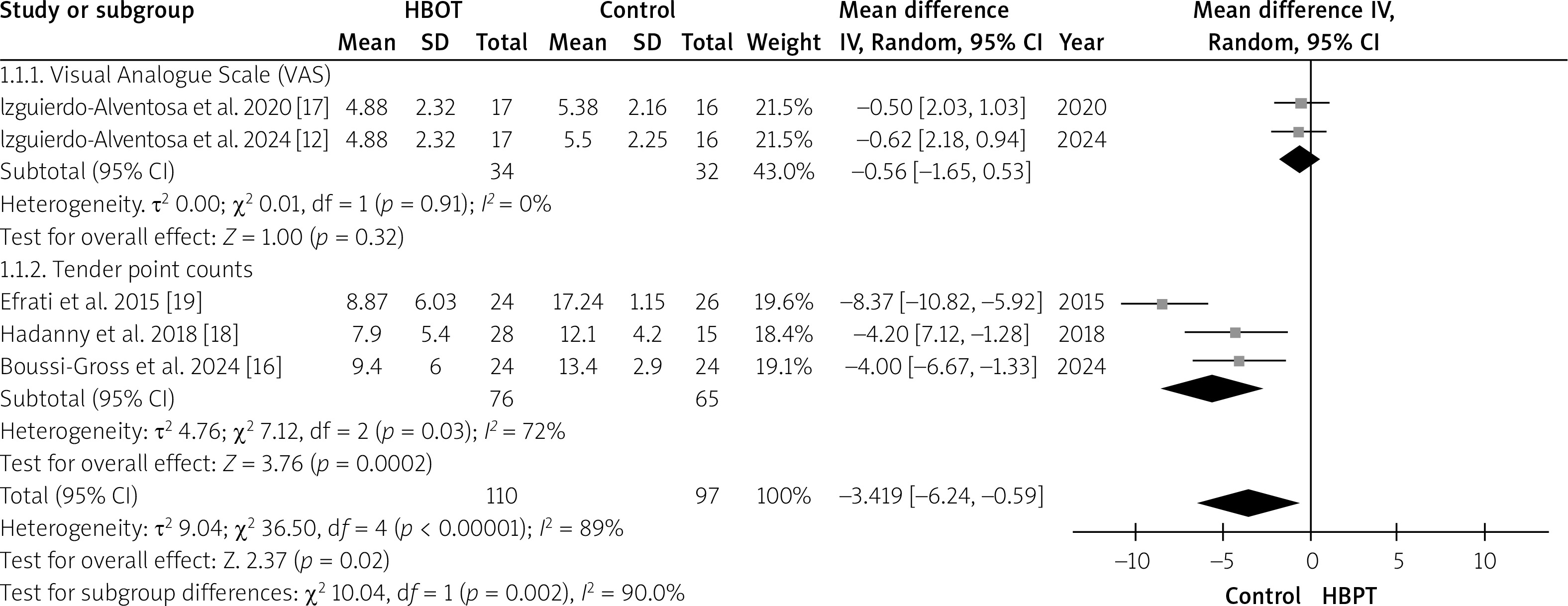
Figure 2 presents the results of the meta-analysis of pain outcomes after treatment with HBOT compared with the control [12, 16–19]. Two of the 5 RCTs used the VAS as outcome measure at the end of HBOT sessions, while 3 studies used tender point counts. Hyperbaric oxygen therapy was associated with a significant reduction in pain compared with the control (MD –3.41, 95% CI: from –6.24 to –0.59, p = 0.02). These findings suggest that HBOT may be effective in alleviating pain in patients with FM. However, substantial heterogeneity (I² = 89%) was observed across studies, indicating considerable variability in the effect estimates, which warrants further research to identify sources of heterogeneity.
Fibromyalgia symptoms severity
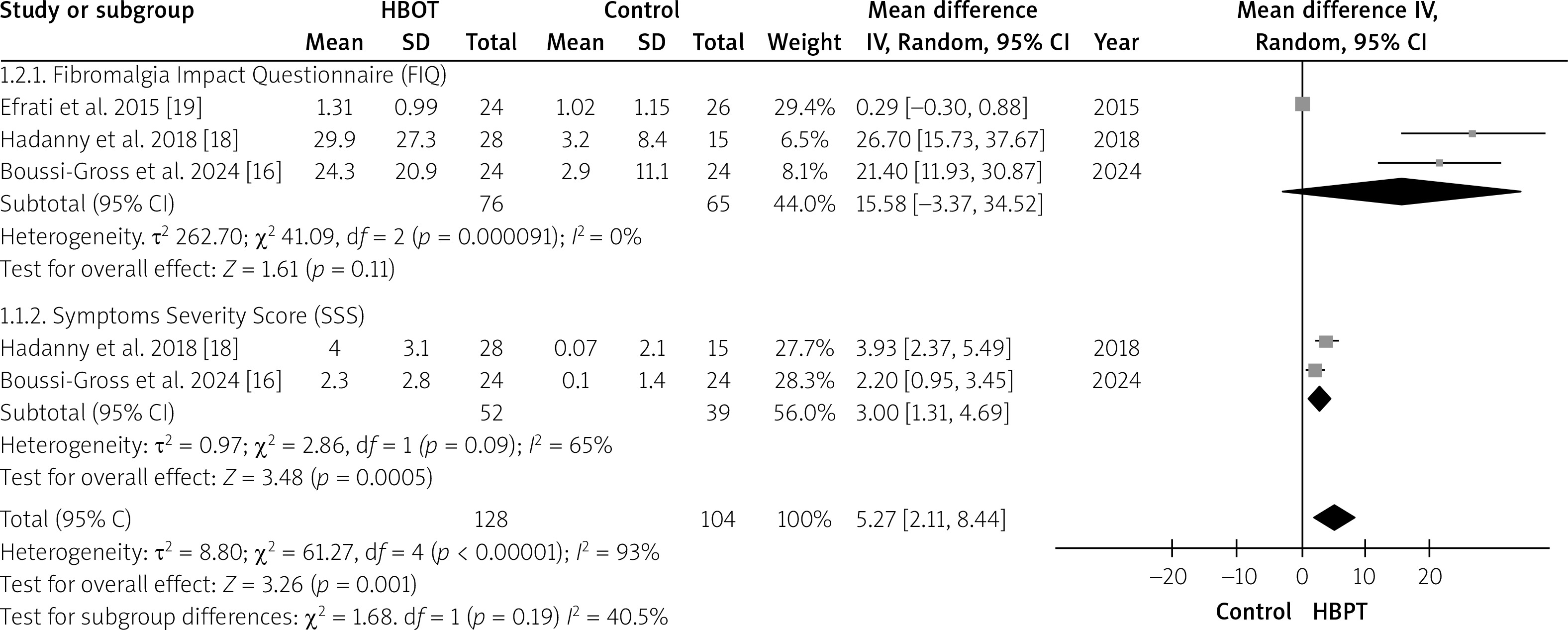
The results of the meta-analysis of FM symptom severity are presented in Figure 3 [16, 18, 19]. The FM symptom severity was described in 3 studies, assessed using the FIQ in all 3 studies and the SSS in 2 studies. Symptom severity was lower in patients treated with HBOT compared to those treated with control interventions (MD = 5.27, 95% CI: 2.11–8.44, p = 0.001). A random-effect model was adopted because of the substantial heterogeneity observed across the included studies (I² = 93%). Consequently, the findings should be interpreted with caution, and further research is needed to explore potential sources of heterogeneity.
Quality of life
The meta-analysis of QoL is shown in Figure 4 [16, 18, 19]. Three of the 5 RCTs assessed the QoL using SF-36. Although the pooled estimate favored HBOT over control interventions, it was not statistically significant (MD 15.75, 95% CI: from –4.38 to 35.87, p = 0.13). Considerable heterogeneity was identified among these studies (I 2 = 93%).

Adverse events
The meta-analysis data presented in Figure 5 show the occurrence of adverse events following HBOT and control interventions [18, 19]. Two studies reported adverse events; the pooled analysis showed a significantly higher incidence of adverse events in the HBOT group compared with the control group [odds ratio (OR) = 53.71, 95% CI: 6.99–412.81, p = 0.0001]. Reported adverse events included dizziness, headache, claustrophobia, increased pain sensation, and mild barotrauma. However, these adverse events were mild and self-limiting, with no serious adverse events reported. Overall, HBOT in patients with FM appeared to be well tolerated despite the higher frequency of adverse events.

Discussion
Fibromyalgia has been associated with disrupted muscle O2 saturation, which may contribute to the fatigue experienced by patients suffering from the condition [20]. The pathophysiology of FM has been linked to autonomic nervous system dysregulation, which may contribute to abnormal vascular constriction and consequently poor O2 delivery. It was also proposed as a potential mechanism underlying microcirculatory dysfunction, thereby limiting the flow of O2-rich blood to muscles [7]. Moreover, mitochondrial dysfunction may increase the production of reactive O2 species, provoking oxidative stress and thus promoting cellular damage and inflammation, which may eventually increase the O2 consumption in the muscle [21].
Hyperbaric oxygen therapy is a non-invasive treatment modality that involves intermittent inhalation of 100% O2 inside an increased ATA chamber [22]. During HBOT, inhalation of 100% O2 produces a positive gradient, thus enhancing O2 diffusion from the hyperoxygenated lung to the circulation. This mechanism increases O2 availability and hemoglobin saturation, which modulate the transport of O2 to hypoxic tissues [23]. Oxygen therapy may have therapeutic potential in FM, as increased O2 delivery to hypoxic musculoskeletal tissues may modulate peripheral and central pain-processing mechanisms, resulting in reduced hyperalgesia and improved pain symptoms [24].
Hyperbaric oxygen therapy was initially used to treat decompression sickness, which occurs when a diver surfaces before the dissolved gases have had time to equilibrate, resulting in space-occupying embolic nitrogen bubbles in the tissues and vasculature. Hyperbaric oxygen therapy elevates the partial pressure of gases and causes a reduction in the volume of the gas-filled spaces, allowing them to dissolve into solution [25].
Over the past few years, HBOT has been increasingly explored for its potential therapeutic benefits. Hyperbaric oxygen therapy has been shown to facilitate myocardial repair and improve left ventricular ejection fraction in acute myocardial infarction and heart failure. HBOT enhances O2 delivery to ischemic tissues, promotes angiogenesis, and significantly suppresses oxidative stress, as well as inflammatory cascades that induce cardiomyocyte apoptosis [26].
Furthermore, HBOT has been observed to improve myelination processes, enhance angiogenesis, and decrease neuroinflammation in the central nervous system of subjects with neurological disorders [27]. Neuroinflammation is a common feature of many neurodegenerative disorders and has been associated with hypoxia-related cellular and molecular changes. Hyperbaric oxygen therapy attenuates neuroinflammation by increasing O2 delivery and enhancing anti-inflammatory cytokine production, resulting in tissue repair and secondary cell death prevention by hindering the apoptotic pathway [28]. In patients with traumatic brain injury, cerebral blood vessels are damaged, causing hypoxia. Hyperbaric oxygen therapy may increase cerebral blood flow through the induction of angiogenesis. Hyperbaric oxygen therapy has been reported to upregulate vascular endothelial growth factor expression, which plays a key role in angiogenesis and vascular repair [29]. Additionally, HBOT has been shown to improve tissue hypoxia, neovascularization, and reperfusion in burns and chronic wounds [30].
In this study, we comprehensively evaluated the efficacy and safety of HBOT for managing FM in female populations. Male and female patients may have different pain thresholds; therefore, this study focused on female patients for more consistent results [31]. After analyzing 5 studies with a total of 227 female participants, our findings suggest that HBOT offers comparable efficacy in pain relief (MD = –3.41, 95% CI: from –6.24 to –0.59, p = 0.02, I² = 89%) compared to the control. Studies by Izquierdo-Alventosa et al. [12, 17] demonstrated that HBOT was associated with a significant reduction of pain intensity, with VAS scores decreasing by 2.47 points (p < 0.001). Moreover, HBOT was associated with a significant reduction in widespread pain in FM, as reflected by lower tender point counts. Boussi-Gross et al. [16] reported a reduction in tender point counts by 4.5 points following HBOT (p = 0.001), while the control group receiving pharmacological therapy showed no change. Hadanny et al. [18] observed a significant reduction of tender point counts by 3.7 points (p < 0.001) in the HBOT group compared to no change in the control group. A study by Efrati et al. [19] revealed an 8.46-point (p < 0.001) reduction in the HBOT group, with no change in the control group. The analgesic effects of HBOT may be ascribed to several potential mechanisms. Evidence suggests that HBOT lowers the activation of glial cells and inflammatory mediators, exerting an anti-inflammatory effect that may contribute to the alleviation of chronic pain [32].
Hyperbaric oxygen therapy may potentially repair persistent brain function damage via promoting neuroplasticity, altering the abnormal pain-related area activity in the brain [33]. Increased O2 in circulation after HBOT also stimulates the synthesis of nitric oxide, which is involved in the pain signaling pathway that activates nitric oxide-dependent opioid anti-analgesic effects [34].
This review indicated that HBOT was associated with alleviation of FM symptoms (MD = 5.27, 95% CI: 2.11–8.44, p = 0.001, I² = 93%). Boussi-Gross et al. [16] and Hadanny et al. [18] reported that HBOT was associated with alleviation of FM symptoms, with a significant reduction (both p < 0.001) in SSS score compared to no change in the control group [16]. Studies by Efrati et al. [19], Hadanny et al. [18], and Boussi-Gross et al. [16] found a significant (all p < 0.001) reduction in the impact of FM symptoms measured with the FIQ, while the control group showed no effect. Although the pooled analysis favored HBOT for QoL outcomes, the difference did not reach statistical significance (MD = 15.75, 95% CI: –4.38 to 35.87; p = 0.13), and substantial heterogeneity was observed among studies (I² = 93%). Nevertheless, the 3 studies that assessed QoL reported significant improvements following HBOT (all p < 0.05) compared to the control [16, 18, 19]. These benefits may be attributable to promotion of blood perfusion to fatigued muscles, hence reducing pain and fatigue [35]. Pain intensity is a significant predictor of QoL in FM patients [36]. Hyperbaric oxygen therapy may also improve QoL by alleviating widespread pain, which has a major negative impact on QoL, since it affects daily activities and work productivity [37].
With respect to safety, adverse events were significantly more frequent among patients receiving HBOT than among controls (OR = 63.30, 95% CI: 8.01–500.05, p < 0.0001, I 2 = 0.0%). However, the reported events were predominantly mild and self-limiting. In a study by Hadanny et al. [18], the reported adverse effects following HBOT were headaches and mild spontaneously resolved barotrauma. Efrati et al. [19] reported mild barotrauma following HBOT, and a few patients discontinued HBOT intervention due to ear pain, claustrophobia, and dizziness. Consistent with the findings of this review, another study reported that adverse events in HBOT with a low chamber pressure below 2.0 ATA were ear discomfort, ocular problems and self-limiting barotrauma, which may be mitigated by compression adjustment and ear-clearing techniques [37].
Although HBOT has demonstrated strong efficacy with minimal safety concerns, its availability remains restricted, and its high cost poses challenges in clinical application [13]. In this context, a more accessible and affordable alternative, such as normobaric oxygen therapy (NBOT), could serve as another practical alternative. Normobaric oxygen therapy involves breathing 100% O2, as in HBOT, but in normal atmospheric pressure. It is widely used to treat chronic pain, such as severe cluster headache [38]. Nonetheless, a trial evaluating the efficacy of HBOT and NBOT in cluster headache pain management indicated a marked reduction in pain intensity within the HBOT group, whereas the NBOT group exhibited no such reduction. However, direct comparisons between HBOT and NBOT did not yield statistically significant differences in pain intensity reduction. Furthermore, evidence regarding the efficacy and safety of NBOT, particularly in FM, remains scarce [39]. Therefore, further comparative studies are needed to clarify the relative benefits of HBOT and NBOT in this population.
Study limitations
Despite the encouraging findings, the study has several limitations. First, only 5 studies with a total of 227 participants were included, which may restrict the generalizability of the results. Second, the small sample sizes of the included studies may account for the wide CI and reduce the precision of the pooled estimates. Third, the substantial heterogeneity (I² = 91.4%) among the included studies raises concerns about the consistency of the results. The variability observed may result from the differences in intervention protocols, notably the varied pressures and exposure times of HBOT, which are closely related to the effectiveness of HBOT. Future large-scale, multicenter RCTs are warranted to further validate these findings. Additionally, future research should aim to establish standardized HBOT protocols, including optimal pressure and the number of HBOT sessions. Addressing these limitations will help strengthen the evidence base and clarify the role of HBOT in the management of FM female patients.
Conclusions
Hyperbaric oxygen therapy appears to be a promising adjunctive treatment for FM, particularly in female patients. The available evidence suggests that HBOT is associated with significant improvements in pain and symptom severity. Although adverse events were more frequent among patients receiving HBOT, they were generally mild and self-limiting, with no serious adverse events reported. However, the current evidence remains limited by the small number of studies, modest sample sizes, and substantial heterogeneity. Further high-quality, multicenter RCTs are needed to confirm the efficacy, safety, and long-term effects of HBOT in FM patients.