Introduction
Systemic sclerosis (SSc) is a complex autoimmune disease characterised by widespread fibrosis, vascular dysfunction, and immune dysregulation. Pulmonary complications, notably interstitial lung disease (ILD) and pulmonary hypertension (PHT), are leading causes of morbidity and mortality in SSc patients. Early identification and treatment of these complications are critical for improving patient outcomes [1]. Despite significant advances in diagnostic tools and treatment strategies, variations in screening practices persist, particularly in resource-limited settings such as Iraq.
High-resolution computed tomography (HRCT) and pulmonary function tests (PFTs) are the primary modalities for ILD detection, whereas echocardiography and right heart catheterisation are recommended for PHT screening. International guidelines emphasise the importance of early and systematic screening to detect lung involvement before irreversible fibrosis develops [2]. Studies have shown that ILD affects up to 50% of SSc patients, with progression rates varying on the basis of disease subtype and risk factors such as the presence of anti-topoisomerase I antibodies [3]. However, global disparities exist in screening and treatment approaches, which are influenced by factors such as physician experience, resource availability, and adherence to guidelines [4].
Multidisciplinary collaboration between rheumatologists and pulmonologists has been shown to improve SSc-ILD and PHT management by integrating imaging findings, functional assessments, and therapeutic interventions [5]. However, there is a lack of documented data on how Iraqi rheumatologists and pulmonologists approach screening and treatment for these pulmonary complications. Understanding current practices in Iraq is essential for identifying gaps in care, improving adherence to evidence-based guidelines, and ensuring early intervention for SSc patients at risk of lung involvement.
This study aimed to assess the attitudes and practices of Iraqi rheumatologists and pulmonologists regarding the screening and management of SSc-ILD and PHT. Iraq represents a middle-income country where access to advanced diagnostic tools and structured multidisciplinary care may be variable. Evaluating local clinical practice patterns may help identify barriers to guideline implementation and inform future efforts to standardise care for patients with SSc-associated pulmonary complications. The findings may also provide insights relevant to other healthcare systems facing similar resource constraints.
Material and methods
Study design
Between August and October 2024, an internet-based survey was administered to Iraqi rheumatologists, pulmonologists, and fellows to survey their attitudes and practices with respect to screening for SSc-related lung disease. The survey consisted of 23 items used to collect data about the participants’ attitudes and practices for the screening and treatment of patients with SSc.
Survey structure
The questionnaire consisted of both checkbox answers and questions that asked about the respondent’s demographic and screening data. The demographic data included age, sex, highest medical qualifications, years of speciality practice, and the average number of SSc patients seen in practice per year. The parameters for screening assessment included questions about whether patients are routinely screened for ILD, the timing for screening patients for ILD, the preferred methods of screening (such as PFTs, HRCT, or serological markers), and the timing for PHT screening. A list of parameters was used to comprehensively evaluate decision-making processes, treatment initiation, monitoring, and criteria for treatment success.
Distribution and participation
The survey was disseminated via social media platforms, specifically through WhatsApp groups for the Iraqi League for Bone and Joint Health and for pulmonologists, with a link to a Google Form. To enhance participation, we sent a reminder in mid-September to stimulate further responses. The majority of participants were from Baghdad Teaching Hospital, Medical City, and other reference centres in Baghdad, Mosul, Basra, and Najaf, representing the main tertiary rheumatology and pulmonology units in Iraq.
Questionnaire design
The questionnaire was developed by the research team based on a comprehensive review of current literature, international practice guidelines (e.g., ACR and EUSTAR), and previously published surveys on SSc-associated ILD and PHT, including those by Hoa et al. [4] and Nicolas et al. [6]. Key domains included clinician demographics, screening practices, diagnostic preferences, treatment decision-making criteria, and interdisciplinary collaboration. The initial draft was reviewed by 2 senior rheumatologists for relevance and clarity. Based on their feedback, minor modifications were made to improve item phrasing and ensure clinical appropriateness. The final version was piloted among 3 rheumatologists to assess comprehensibility and time required to complete the survey. Their feedback supported the clarity and acceptability of the questionnaire.
Data analysis
Responses were analysed by the authors and categorised into themes to summarise the findings effectively.
Bioethical standards
The study was reviewed by the Institutional Review Board of the College of Medicine, University of Baghdad, and received a waiver of formal ethical approval as it involved a voluntary, anonymous survey of healthcare professionals with no patient data collection. Healthcare professionals viewed the invitation to participate in social media. Clicking on the button to “fill out the form” is considered the equivalent of consenting to participate in the survey.
Results
Survey response and participant characteristics
A total of 116 participants completed the survey. The participant characteristics and features of patient recruitment are summarised in Table I. Among the responders, 88 (75.9%) were rheumatologists, and 28 (24.1%) were pulmonologists who were ILD experts. Fifty-nine (51.8%) had a diploma degree, 33 (29.8%) had a board-certified degree, and 24 (18.4%) had a fellowship in rheumatology and pulmonology as their highest medical qualifications. Six (5.1%) had more than 30 years of practice in the speciality, 46 (38.8%) had 10–20 years of practice, 30 (25.9%) had 5–10 years, and 34 (30.2%) had 0–5 years. The estimated proportions of SSc patients per participant were as follows: < 5 (47%), 6–9 (10%), 10–30 (33%), 31–50 (5%), 51–99 (3%), > 100 (4%).
Table I
Demographic and clinical practice characteristics of surveyed specialists
Interstitial lung disease screening in newly diagnosed systemic sclerosis patients
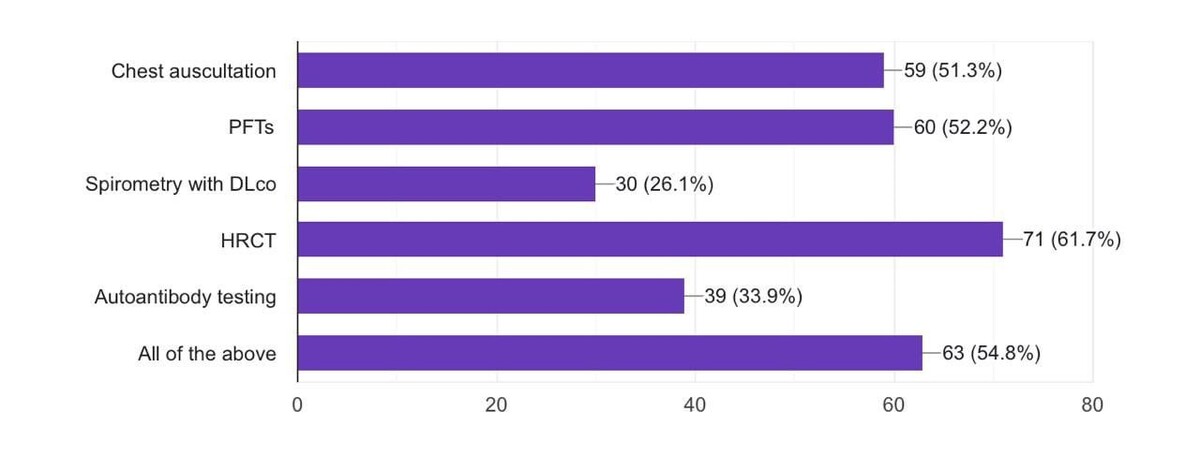
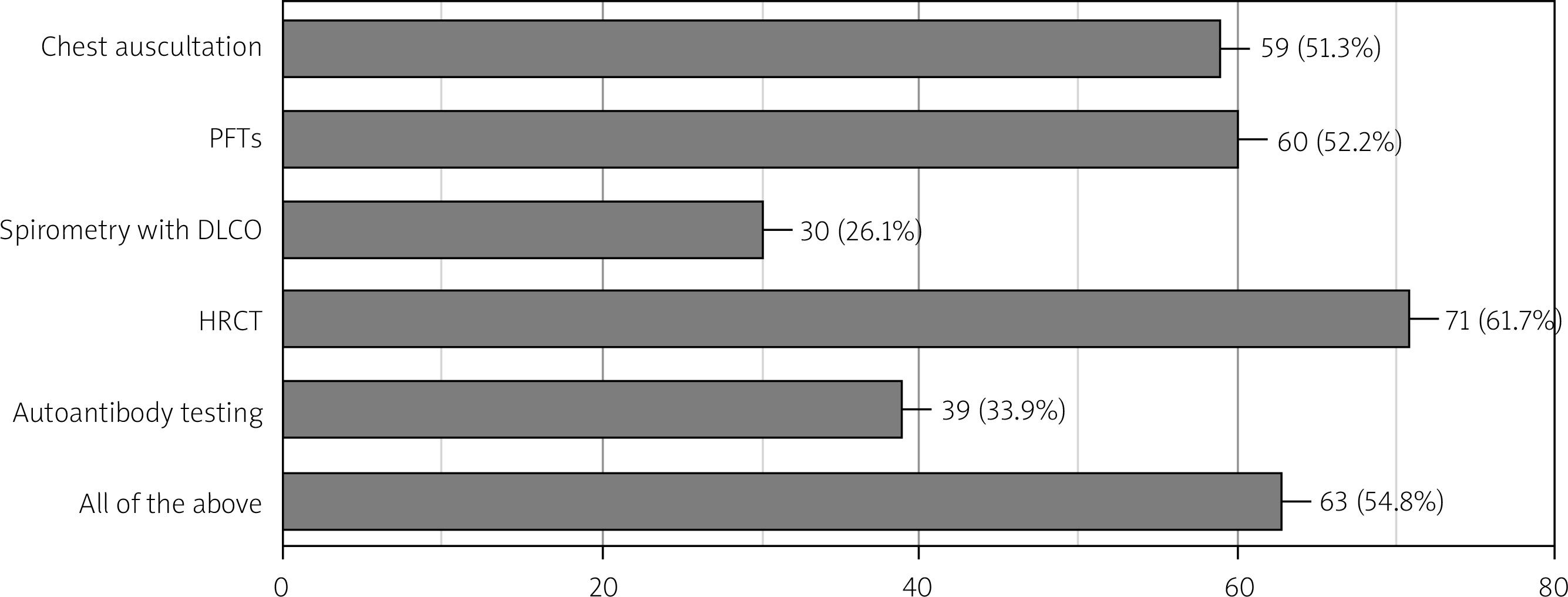
Out of 116 participants, 103 (88.8%) reported routinely screening newly diagnosed patients for ILD; 10 screened only occasionally, while 3 did not screen for ILD. Table I indicates that 72 participants (62.1%) conducted screenings at the time of diagnosis, whereas 39 participants (33.6%) performed screenings only when patients exhibited symptoms. Additionally, 2 participants screened based on serological findings, and 3 participants indicated that their screenings are related to other findings. Seventy-one individuals, representing 61.7%, depended on HRCT scans. Sixty individuals, representing 52.2%, systematically prescribe PFTs. Thirty participants, representing 26.1%, reported using spirometry with diffusing capacity of the lungs for carbon monoxide (DLCO). Thirty-nine participants (33.9%) conducted autoantibody screening for ILD, 59 (51.3%) assessed chest auscultation, and 63 (54.8%) performed all the aforementioned measures during the screening process (Fig. 1).
Screening for pulmonary hypertension in systemic sclerosis patients with interstitial lung disease
Routine screening for PHT was reported by 36 (31%) participants; 48 (41.4%) screened for PHT only when shortness of breath (SOB) was not explained by ILD progression; 25 (21.6%) screened once per year; and 7 (6%) did not screen for PHT (Table I). Table II shows the descriptive differences in answers between rheumatologists and pulmonologists.
Table II
Comparison of interstitial lung disease and pulmonary hypertension screening practices between rheumatologists and pulmonologists
Treatment decision-making criteria
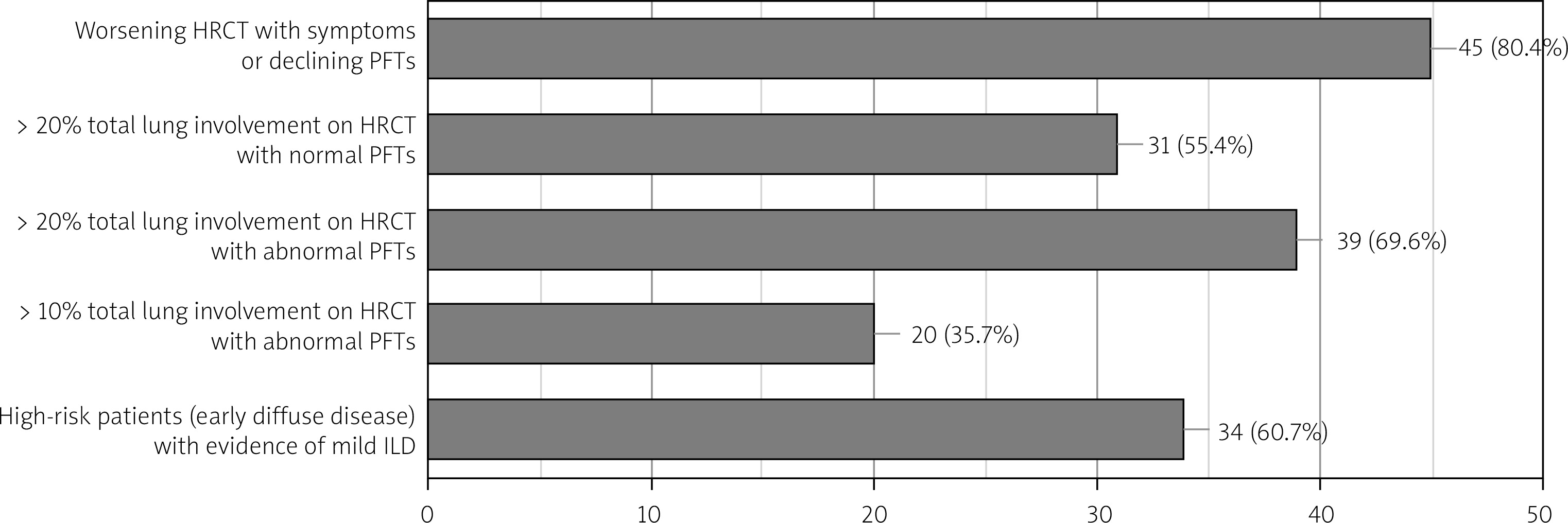
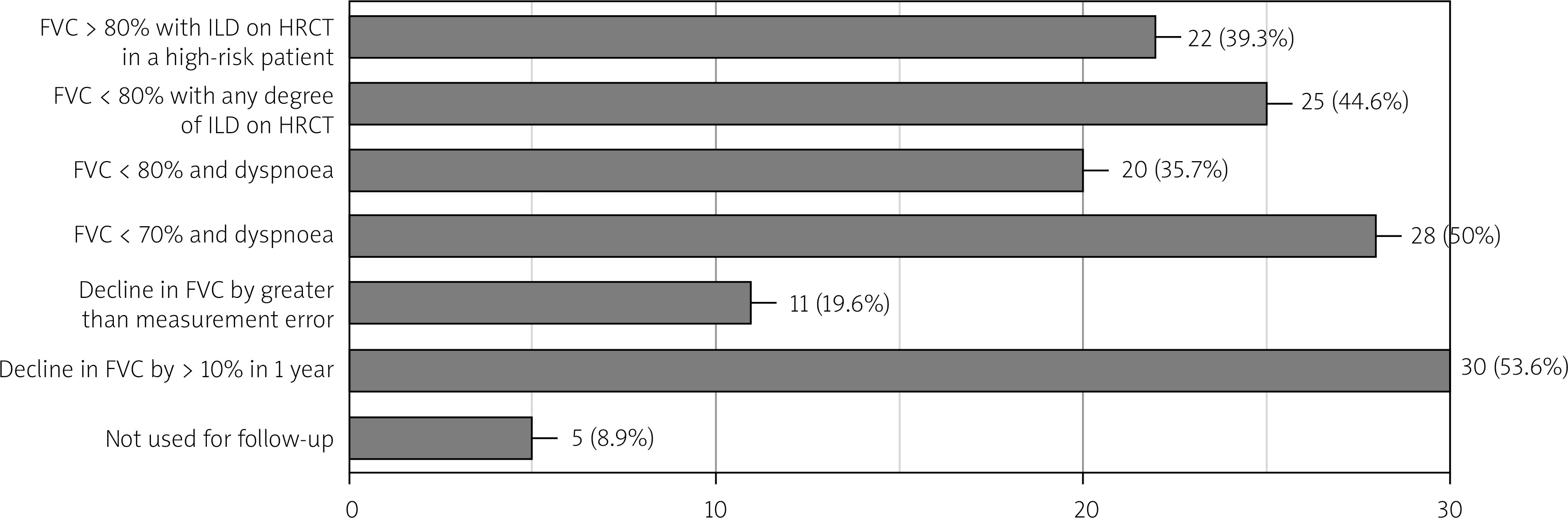
The treatment decision survey was completed by 56 out of the 116 participants. The key features for initiating treatment for SSc-ILD, listed in descending order of frequency, include the extent of ILD or fibrosis on HRCT (94.6%), clinically meaningful changes with a decline in PFT values (64.3%), the presence of PHT (51.8%), the duration and degree of dyspnoea (48.2%), and the baseline PFT value (44.6%). Among HRCT findings, the most commonly used parameter for initiating treatment is the worsening of HRCT in conjunction with symptoms or declining PFTs (80.4%). This is followed by > 20% total lung involvement on HRCT with abnormal PFTs (69.6%), high-risk patients (early diffuse disease) exhibiting mild ILD (< 10%) and abnormal PFTs (60.7%), > 20% total lung involvement on HRCT with normal PFTs (55.4%), and > 10% total lung involvement on HRCT with abnormal PFTs (35.7%) (Fig. 2). Among PFT parameters, assuming the presence of ILD on HRCT, a decline in forced vital capacity (FVC) by > 10% in 1 year was considered to be the most frequently used parameter for initiating treatment (53.6%). This was followed by FVC < 70% and dyspnoea (50%), FVC < 80% with any degree of ILD on HRCT (44.6%), FVC > 80% with ILD on HRCT in a high-risk patient (early diffuse disease, positive anti-topoisomerase antibody) in 39.3%, FVC < 80% and dyspnoea in 35.7%, and a decline in FVC by greater than measurement error in 19.6%, whereas 8.9% did not use PFTs for follow-up (Fig. 3). In response to the question regarding which patients should not receive treatment, 69.6% indicated no progression of ILD over recent years; 25% cited stable PFTs, whereas 5.4% referred to patients with longstanding disease nearing 10 years. The most commonly reported triggers for immediate treatment at initial presentation were moderate-to-severe ILD on HRCT (80.4%), hypoxia at rest (69.6%), and HRCT showing ILD > 20% lung involvement (66.1%). Other triggers included moderate-to-severe symptoms (60.7%), an early, rapidly progressive diffuse subset even with mild abnormalities on HRCT chest scan and mild abnormalities on PFT (53.6%), an early, rapidly progressive diffuse subset even with mild abnormalities on HRCT chest scan (51.8%), desaturation on exercise (42.9%), an early, rapidly progressive diffuse subset even with mild abnormalities on PFT (37.5%), and FVC and/or DLCO below the lower limit of normal (35.7%). The criteria for identifying treatment responders were findings or changes on HRCT (80.4%), findings or changes on PFTs (50%), and duration of symptoms (48.2%).
Therapeutic approaches
Mycophenolate mofetil (MMF) is the first-choice treatment for SSc-ILD in 87.5% of cases. Rituximab was chosen by 7.2% of respondents, azathioprine by 1.8%, and nintedanib by 1.8%. Their most likely course of action was determined on the basis of the response to treatment regarding the progression or worsening of ILD. Although MMF was the most frequently prescribed therapy, some respondents also reported using cyclophosphamide, particularly in cases of severe or rapidly progressive ILD, consistent with historical evidence supporting its role in SSc-ILD management. Specifically, 83.9% would add another agent for progression or worsening, 76.8% would continue the current treatment for stability, 3.6% would add another agent despite stability, and 1.8% would switch to another agent for stability. The primary circumstances prompting weaning from therapy included drug toxicity (including side effects and adverse events) in 55.4%, the patient’s strong desire to discontinue treatment in 46.4%, a lack of efficacy in 46.4%, stability for 2 or more years in both lung and skin conditions in 39.3%, and all of the above factors in 55.4%.
Tapering approach
Participants undertake tapering or weaning over 1–2 years with monitored PFTs every 6 months, with or without a low maintenance dose of MMF in 75% and 21.4% would taper to a lower maintenance dose within months to a year, and 3.6% would stop therapy quickly (over weeks).
Parameters considered for disease progression were highest for changes in PFT over time, 82.1%. Their response to the defined criteria for treatment success was highest for symptom stabilisation/improvement (76.8%), followed by FVC improvement (64.3%), FVC stabilisation (58.9%), HRCT improvement (58.9%), HRCT stabilisation (58.9%), DLCO improvement (50%), DLCO stabilisation (46.4%), O2 saturation with exercise (44.6%), 6-minute walk distance stabilisation/improvement (41.1%), and functional status (New York Heart Association functional class or cardiopulmonary exercise testing) (28.6%).
When managing patients, 89.3% of participants collaborate frequently with other specialists in clinical practice, while 10.7% collaborate occasionally.
Discussion
This study offers valuable insights into the screening attitudes and practices of Iraqi rheumatologists and pulmonologists regarding ILD and PHT in SSc patients. The findings reveal notable variability in screening practices, decision-making, treatment approaches, and outcome assessment, which are influenced by clinical experience, resource availability, and individual attitudes toward early detection and treatment.
Participant characteristics and expertise
The participant cohort primarily consisted of rheumatologists (75.9%) and ILD pulmonologists (24.1%), with a smaller proportion of postgraduate trainees. The diversity in medical qualifications and years of practice, particularly with 46.6% having less than 10 years of experience, may have contributed to the observed heterogeneity in the responses. This suggests a tendency among less experienced clinicians to adhere more strictly to guideline-based approaches. The study highlights the need for standardised, evidence-based protocols for SSc screening to address this variability.
Interstitial lung disease screening practices
A significant proportion of clinicians (88.8%) routinely screen for ILD in patients with SSc, yet notable variability exists in the timing and methods employed. While 62.1% of practitioners initiate screening at diagnosis, 33.6% defer until symptom onset. This delay may be influenced by resource limitations or differing interpretations of guidelines, despite the critical importance of early ILD detection for optimal management and prevention of irreversible damage [7].
The observed variability in screening practices may be attributed to several factors, including differences in clinical experience, resource availability, and personal attitudes towards guideline recommendations.
Compared with the findings reported by Nicolas et al. [6] in France, the use of chest computed tomography (CT) scans for our study (61.7%) is in line with the track record sensitivity of CT for the detection of ILD at initial stages. However, the limited use of PFTs and DLCO assessments in our cohort is a significant contrast. Nicolas et al. [6] also highlighted the common use of PFTs and DLCO in practice worldwide, notably as adjunctive diagnostic support to CT scans in the detection of ILD.
Furthermore, the study by Rahaghi et al. [8] reinforced the recommendation for a multidisciplinary approach to ILD screening in SSc patients by emphasising the combined application of clinical reasoning, imaging, and functional capacity (i.e., PFTs, DLCO). However, in this study, only 52.2% of respondents reported that they actually used PFTs, and only 26.1% reported performing DLCO tests, which suggests incomplete adherence to evidence-based screening recommendations. This underutilisation can also be explained by access problems or limited access to equipment in specific areas and has therefore created the need for better resource management and clinician training to better comply with the guidelines. Our findings also align with the expert consensus of Rahaghi et al. [8], which emphasises the need for systematic and multidisciplinary approaches combining HRCT, PFTs, and DLCO. The underutilisation of DLCO in our Iraqi cohort contrasts with the consensus recommendation, highlighting the gap between evidence-based recommendations and real-world practice in resource-limited settings.
Similarly, the study by Hoa et al. [4] revealed significant international variability in ILD screening approaches, with differing reliance on HRCT, PFTs, and DLCO testing. While our findings align with their observation that HRCT remains the preferred screening tool globally, our cohort demonstrated a lower frequency of DLCO use than international data did. This discrepancy highlights regional disparities in screening accessibility and practice, reinforcing the need for localised adaptations of international guidelines.
Pulmonary hypertension screening practices
Our survey highlighted considerable variability in PHT screening practices among SSc patients with ILD. While 31% of the respondents reported routine screening for PHT, a significant proportion (41.4%) restricted screening to cases of unexplained SOB, and 21.6% conducted annual screenings. This discrepancy suggests suboptimal adherence to guidelines and thus highlights the need for routine PHT screening to identify and treat PHT early. Given the significant mortality of PHT in SSc patients, these data highlight an important area for improvement and underscore the need to strengthen adherence to guideline-recommended screening practices.
The reluctance to perform routine PHT screening, even among symptomatic patients, may be attributed to resource constraints, particularly limited access to echocardiography and right heart catheterisation, both of which are resource-intensive diagnostic modalities. This finding is supported by Johnson et al. [7], who suggested the use of echocardiography as a fundamental part of PHT screening by SSc-related clinical screening centres but noted that the practice of using echocardiography is heterogeneous due to discrepancies in resource usage. Similarly, Nicolas et al. [6] noted an increase in echocardiography and invasive diagnostic workups in “resource-rich” countries that have direct consequences for economics and infrastructure for screening activity. According to current recommendations, the DETECT algorithm is endorsed for pulmonary arterial hypertension screening in SSc [9]. Our survey did not specifically include DETECT in the questionnaire; thus, it remains unclear to what extent this algorithm is applied in Iraqi practice.
Our findings align with broader literature, which identifies resource limitations and varying clinical practices as significant barriers to implementing guideline-based screening protocols. The variation observed in this study can be explained by global patterns, especially in low- and middle-income countries where the application of complete screening algorithm recommendations is still a challenge. Addressing these disparities through targeted resource allocation and clinician education may help bridge the gap and improve outcomes for SSc patients at risk of PHT.
Hoa et al. [4] also reported global disparities in PHT screening, with some centres adhering strictly to guideline-based echocardiographic evaluations and others relying on clinical suspicion. Our findings reflect a similar pattern, with a reliance on symptom-based screening rather than proactive assessment. This further underscores the necessity of strengthening systematic screening approaches to enhance early detection and management.
Treatment decision practices
Our survey revealed that only 50% of the respondents completed the predefined treatment decision survey for SSc-ILD. In addition, 94.6% of the respondents rated the extent of ILD or fibrosis on HRCT as the most important factor for starting the treatment. This practice is in accordance with recent recommendations that favour HRCT as the reference standard for the detection and quantification of ILD [10].
Furthermore, 80.4% of participants rated symptoms or deterioration in PFTs as being the most important factor in making treatment decisions, while 69.6% considered more than 20% lung involvement on HRCT in conjunction with abnormal PFTs as a criterion. Together, these findings emphasise the importance of integrating structural imaging with functional assessment in the management of SSc-ILD.
However, there was notable variability in PFT thresholds for initiating therapy: 50% of respondents used a FVC of less than 70% as a criterion, whereas 44.6% employed a threshold of less than 80%. This disparity highlights the absence of a universal consensus and underscores the need for standardised protocols to guide treatment initiation.
Regarding therapeutic approaches, our finding is that 87.5% of respondents prefer MMF as first-line therapy. This preference reflects evidence supporting the efficacy of MMF in stabilizing or improving lung function in SSc-ILD patients [11, 12]. This finding is also consistent with the preferences reported by Nicolas et al. [6], who noted the prominence of MMF in clinical practice because of its ability to stabilise or improve lung function. These findings are also consistent with the latest European Alliance of Associations for Rheumatology 2023 recommendations, which emphasise MMF as first-line therapy, while recognising cyclophosphamide, nintedanib, and biologics in specific scenarios [13]. Additionally, we report that changes in therapy in stable patients were managed cautiously, which mirrors the findings of a French study that reflects concerns about toxicities and a lack of data for combination therapies. In contrast, rituximab (7.2%) and azathioprine (1.8%) were less commonly selected, possibly owing to limited supporting evidence in this context [13, 14].
In cases of disease progression, 83.9% of participants indicated that they would escalate therapy by adding another agent, whereas 76.8% would continue MMF in patients exhibiting disease stability. Notably, only 3.6% would consider adding another agent despite stability, and a mere 1.8% would opt to switch therapy in stable patients. This cautious approach to modifying treatment in stable cases likely reflects concerns over potential toxicity and the limited data on combination therapies for SSc-ILD.
When considering tapering strategies, 75% of respondents favoured a gradual reduction in therapy over 1–2 years, with PFT monitoring every 6 months. This approach aligns with clinical practices aimed at minimising drug-related toxicity while maintaining disease stability [15]. However, 21.4% preferred a more rapid tapering regimen, and 3.6% discontinued therapy abruptly, potentially increasing the risk of disease progression. This variation underscores the need for robust evidence to guide tapering strategies, particularly in long-term responders.
Our findings parallel those of Hoa et al. [4], who noted that treatment initiation criteria varied widely among international centres. While HRCT remains the cornerstone for decision-making, there is no universal agreement on PFT thresholds, reflecting the ongoing debate regarding the optimal timing for intervention. This suggests that international guideline harmonisation remains a key priority for improving patient outcomes.
Criteria for treatment success
Symptom stabilisation or improvement (76.8%) and FVC improvement (64.3%) were the most frequently mentioned indicators of treatment success, followed by HRCT stabilisation (58.9%). These parameters are in line with existing recommendations for monitoring SSc-ILD progression with prioritisation of functional and structural stability over significant improvement owing to this condition’s chronic, fibrotic nature.
Multidisciplinary cooperation forms the bulwark of SSc-ILD management, where 89.3% of respondents would often collaborate with other specialists, such as pulmonologists and radiologists. This finding indicates that complex SSc-ILD usually involves experts who assess pulmonary and systemic involvement and tailor individualised treatment plans accordingly [15].
Study limitations
This study has several limitations. The reliance on self-reported data may introduce response bias, and the survey’s cross-sectional design limits the ability to establish causality. Additionally, although participants represented a range of specialties, experience levels, and clinical practice settings, the sample may not fully capture the diversity of practices across different healthcare settings in Iraq. Similar studies in other regions have reported similar challenges, indicating that methodological limitations are a common issue in this field [16].
While the findings provide valuable insights into screening practices within the Iraqi context, their generalisability to other regions may be limited by differences in healthcare infrastructure and resource availability. Nonetheless, the results highlight common challenges that may be applicable in similar resource-constrained settings. This is consistent with global studies emphasising the need for adaptable guidelines tailored to varying resource environments [17]. As emphasised by Hoa et al. [4], variability in ILD and PHT management is not unique to Iraq but rather a global issue, reinforcing the need for more adaptable and region-specific guideline implementation.
Furthermore, while studies from high-income countries have documented adherence trends and outcomes related to SSc-ILD management, data from the Middle East – and Iraq in particular – remain scarce. This study fills a critical gap by providing the first national-level insight into SSc pulmonary screening practices in Iraq, highlighting both areas of strength (e.g., widespread HRCT use) and key gaps (e.g., underuse of DLCO and inconsistent PHT screening). These findings contribute to the global understanding of barriers to optimal care and may support the development of scalable, regionally adapted protocols for SSc-ILD management.
Conclusions
This study underscores the need for standardised, evidence-based screening protocols for ILD and PHT in SSc patients in Iraq. Addressing the identified gaps requires improving access to diagnostic tools, enhancing clinician education, and fostering multidisciplinary collaboration. The comparison with international practices highlights areas for improvement and adaptation of global guidelines to local contexts. Future research should focus on identifying barriers to guideline implementation and evaluating the impact of standardised practices on patient outcomes.