
Introduction
Magnesium is an essential mineral involved in numerous physiological processes, playing a key role in maintaining the function of different systems in the human body [1, 2]. It participates in numerous enzymatic reactions, influencing energy metabolism, protein synthesis, and neurotransmission [1]. About 60% of magnesium is primarily stored in bones and 40% in soft tissues, with only a small fraction (approximately 1%) circulating in the blood [3, 4].
Juvenile idiopathic arthritis (JIA) is the most common chronic rheumatic disease in children, characterized by persistent joint inflammation and immune dysregulation [5, 6]. Emerging evidence suggests that micronutrient imbalances may contribute to disease activity and symptom severity in JIA patients [7, 8]. Magnesium is known to modulate inflammatory pathways by regulating cytokine production, oxidative stress, and immune cell function [9, 10]. Deficiency of this essential mineral may exacerbate inflammatory responses, potentially worsening joint damage and systemic manifestations in JIA [11].
Several factors can contribute to inadequate magnesium levels in children with JIA, including insufficient dietary intake, chronic inflammation, malabsorption, and renal losses [12]. Studies have indicated that dietary magnesium intake is often below recommended levels in pediatric populations, particularly among adolescents [13–16]. Given the potential implications of magnesium deficiency on immune function and inflammation, understanding its role in JIA is essential for optimizing disease management and improving patient outcomes.
The aim of this study was to assess dietary magnesium intake and serum magnesium levels in children with JIA and to evaluate their potential impact on the clinical course of the disease.
Material and methods
Study design and methodology
This case-control study included 42 children with JIA aged 2 to 18 years and 67 healthy children aged 6 to 18 years. The examination of children with JIA was conducted both during hospitalization and at outpatient visits during routine check-ups. Children in the control group were assessed during scheduled preventive medical examinations.
Patients were included in the JIA group if they met the International League of Associations for Rheumatology (ILAR) criteria for JIA [17] and provided informed consent from the child and/or their parents. Exclusion criteria included the presence of acute or other chronic diseases and renal dysfunction, and intake of magnesium supplements in the last 6 months. The control group consisted of children without acute or chronic diseases, with no intake of magnesium supplements in the last 6 months, and with informed consent from the child and/or their parents.
Data collection and assessment
Data collection was conducted through interviews, where basic characteristics such as age, sex, place of residence, and parental education were recorded. Medical records were reviewed to determine JIA subtypes, disease duration, and treatment regimens. Physical examinations included anthropometric measurements and disease activity assessment. The classification of inactive disease followed the Wallace criteria [18].
Dietary magnesium intake was assessed using a food frequency questionnaire, which collected information on the weekly consumption of specific foods rich in magnesium. Data on dietary magnesium intake were available for 26 out of 42 JIA patients because only these participants (and their caregivers) completed the validated food frequency questionnaire in full. For the remaining 16 subjects, incomplete or unreliable dietary data were excluded from the analysis to ensure accuracy.
The food list included key dietary items commonly consumed by children of various ages, considering their magnesium content. Each child, with parental assistance, reconstructed their weekly diet, specifying portion sizes for each food item. For younger children (aged 2 to 9 years), parental guidance was essential in recalling dietary intake.
Using a database of magnesium content in foods [15, 19], the average weekly and daily magnesium intake was calculated. The total dietary magnesium intake was compared with national and international dietary recommendations for vitamins and minerals in children [19]. Nutrient intakes below 67% of the recommended daily allowance were considered deficient, as this level indicates a risk of inadequate intake [14, 15].
Additionally, serum magnesium levels were measured using an ELISA assay kit (Elabscience, USA) via a colorimetric method. In children older than 5 months, normal serum magnesium levels range from 0.70 to 0.95 mmol/l, with hypomagnesemia defined as levels below 0.7 mmol/l [1, 2].
Statistical analysis
Statistical analysis was performed using STATISTICA 10.0 and Microsoft Excel 2003. For normally distributed data, the mean (m) and standard deviation (SD) were calculated. Data were processed using variation statistics, and Student’s t-test was applied to compare mean values.
For non-normally distributed data, values are presented as the median and interquartile range (IQR) [25%; 75%]. Comparisons between two independent groups were conducted using nonparametric statistics, specifically the Mann-Whitney U test. Frequency distributions between groups were compared using the chi-square (χ²) test. Differences were considered statistically significant at p < 0.05. To assess the impact of potential risk factors, odds ratios (OR) and 95% confidence intervals (CI) were calculated based on variables that demonstrated statistical significance.
Results
Among 42 patients with JIA, there was an equal distribution of boys and girls (Table I). No significant differences were observed regarding urban or rural residence within this cohort. A smaller proportion of parents had higher education (p = 0.09). The mean disease duration was 3.52 ±2.17 years, ranging from 6 months to 8 years.
Table I
Baseline characteristics of patients with JIA and healthy children
| Characteristic | JIA patients (n = 42) | Healthy children (n = 67) |
|---|---|---|
| Sex [n (%)] | ||
| Male | 21 (50.0) | 35 (52.2) |
| Female | 21 (50.0) | 32 (47.8) |
| Place of residence [n (%)] | ||
| Rural | 22 (52.4) | 17 (25.4)*^ |
| Urban | 20 (47.8) | 50 (74.6) |
| Parents’ education [n (%)] | ||
| Higher | 15/42 (35.7)* | 35/67 (52.2) |
| Secondary | 27/42 (64.3) | 32/67 (47.8) |
| Age at visit [years], mean ±SD | 10.98 ±4.61 | 11.69 ±3.67 |
| BMI, mean ±SD (min–max) | 18.89 ±3.66 (14.35–27.45) | 19.65 ±4.09 (13.17–28.26) |
| JIA duration [years], mean ±SD (min–max) | 3.52 ±2.17 (6 months–8 years) | |
| JIA [n (%)] | ||
| Active disease | 16 (38.1)* | |
| Inactive disease | 26 (61.9) | |
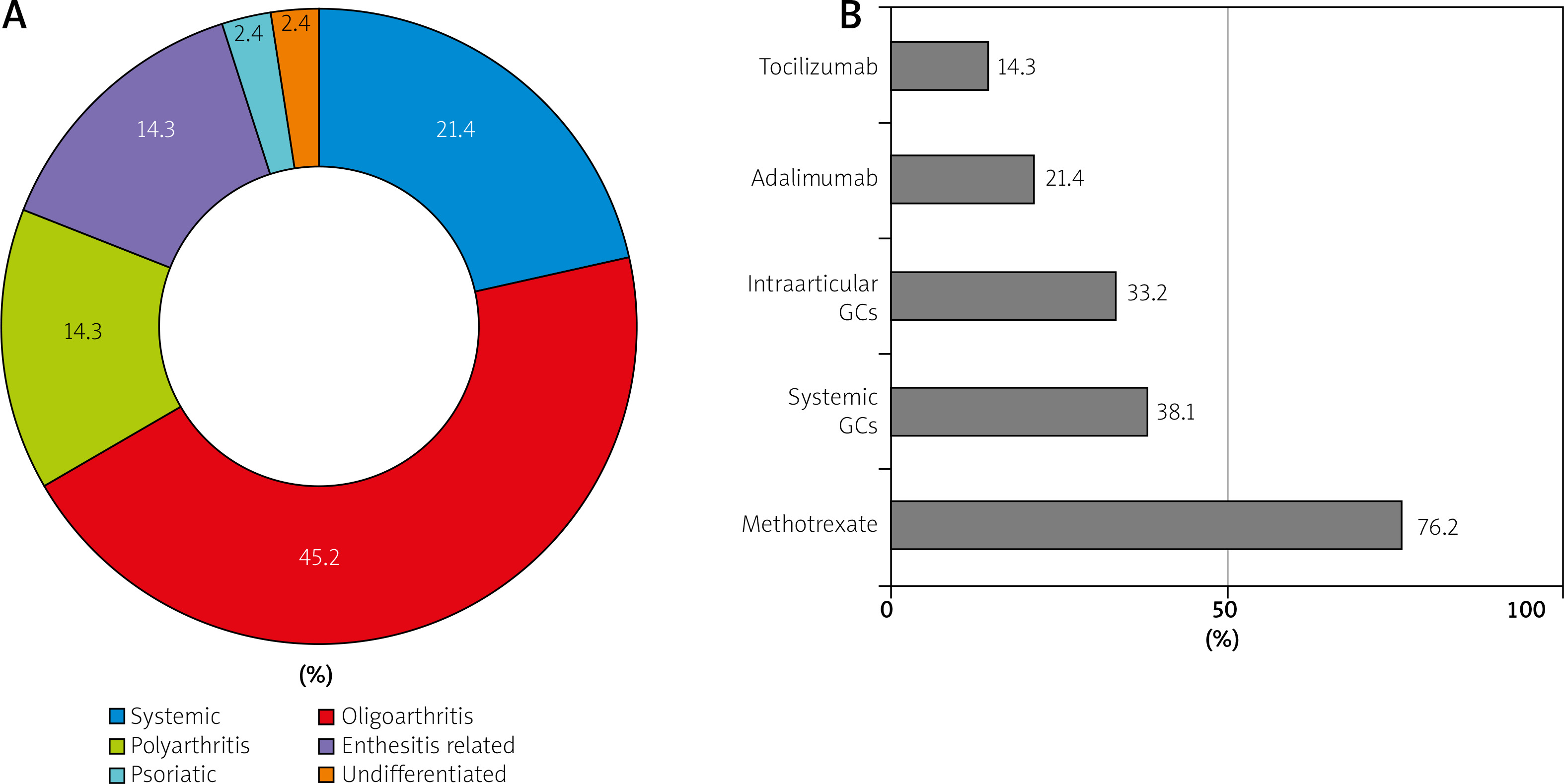
Among the JIA types, oligoarthritis was the most prevalent (19/45.2%), followed by systemic arthritis (9/21.4%). Other JIA types were less common (Fig. 1A). The majority of children (26/61.9%) were in an inactive disease stage at the time of evaluation (p = 0.029). Methotrexate was the most frequently used medication (32/76.2%), while 15/35.7% received biologic therapy, most commonly adalimumab (9/21.4%) (Fig. 1B).
Fig. 1
Clinical characteristics of patients with JIA: A) types of JIA, B) JIA treatment.
GCs – glucocorticosteroids, JIA – juvenile idiopathic arthritis.
Among healthy children, no differences were found in sex distribution or parental education; however, urban residents predominated (p < 0.001).
A comparison of patients with JIA and healthy controls based on baseline characteristics (Table I) revealed a significant difference only in place of residence: children with JIA were more likely to live in rural areas (p = 0.004). No significant differences were observed between the 2 groups in terms of sex, parental education, age, or body mass index (BMI).
Daily dietary magnesium intake and serum magnesium levels in children with JIA and healthy controls are presented in Table II. Daily magnesium intake was assessed in 26 of the 42 JIA patients, whereas serum magnesium levels were available for all participants. The median daily magnesium intake was significantly lower in children with JIA compared to healthy children (p = 0.040). Additionally, a greater proportion of children in the JIA cohort had inadequate dietary magnesium intake (p = 0.034). The risk of JIA was 2.72 times higher in children with insufficient magnesium intake (OR = 2.722; 95% CI: 1.064–6.966; p = 0.037).
Table II
Daily dietary magnesium intake and serum magnesium concentration in JIA and healthy patients
When stratified by age, it was found that among children under 12 years old, the proportion of those with inadequate magnesium intake was significantly higher in the JIA group than in healthy controls (p = 0.016). However, this difference was not observed in children over 12 years of age (Table III), as the percentage of healthy adolescents with low dietary magnesium intake was also high.
Table III
Insufficient dietary magnesium intake in patients with JIA and healthy children according to age
| Group | Insufficient dietary magnesium intake | |
|---|---|---|
| Before 12 years | After 12 years | |
| JIA patients [n (%)] | 4/13 (30.8) | 9/13 (69.2) |
| Healthy children [n (%)] | 2/37 (5.4) | 16/30 (53.3) |
| p | 0.016 | 0.332 |
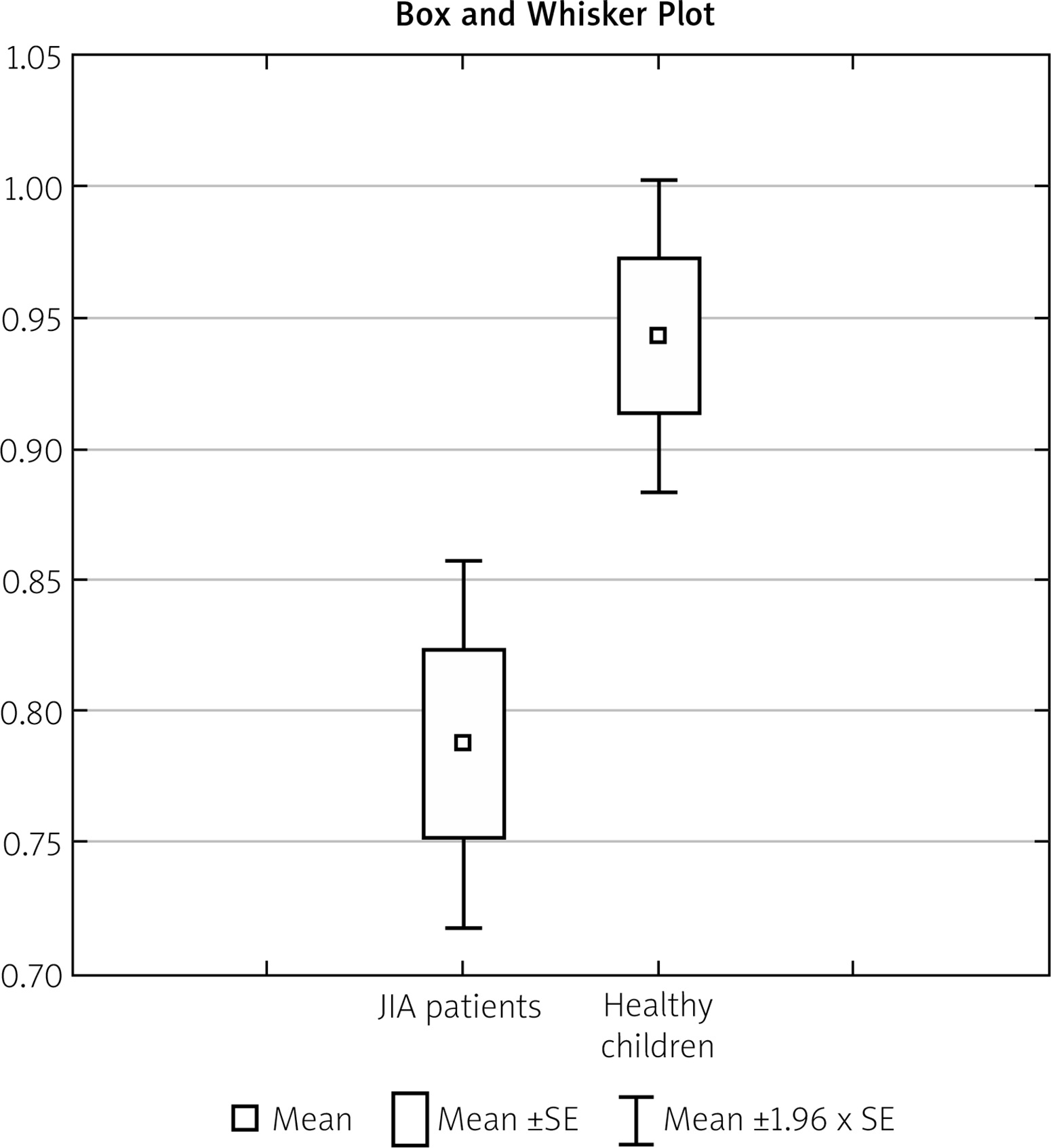
The mean serum magnesium concentration was lower in children with JIA compared to healthy controls (p = 0.009) (Fig. 2), although the proportion of children with hypomagnesemia did not differ significantly between the groups.
Fig. 2
Mean serum magnesium (mmol/l) in JIA patients and healthy controls (p = 0.009).
JIA – juvenile idiopathic arthritis.
When comparing the baseline and clinical characteristics of JIA patients based on dietary magnesium intake, it was found that children with insufficient dietary magnesium intake were more likely to be male (p = 0.006), over 12 years of age (p = 0.049), and residing in urban areas (p = 0.002) (Table IV). No significant differences were observed concerning parents’ education level, BMI, disease duration, or disease activity. Serum magnesium concentration was also not associated with dietary magnesium intake.
Table IV
Basic and clinical characteristics of patients with JIA according to magnesium dietary intake
Hypomagnesemia was more common in boys (p = 0.030). Comparing the other baseline and clinical characteristics of JIA patients based on the presence or absence of hypomagnesemia showed no statistically significant differences in terms of age, place of residence, parents’ education level, age at visit, BMI, disease duration, or disease activity (Table V). Although daily dietary magnesium intake was lower among children with hypomagnesemia, the difference was not statistically significant.
Table V
Basic and clinical characteristics of patients with JIA according to magnesium status
Discussion
The main clinical characteristics of patients with JIA, such as age, disease subtype, and duration, are consistent with findings from previous studies [20, 21], although a predominance of females has been reported in other JIA cohorts [21].
Our study demonstrated that children with JIA had significantly lower median dietary magnesium intake than healthy controls (p = 0.040), and the proportion of children with insufficient dietary magnesium intake was significantly higher in the JIA group (p = 0.034).
Most previous studies examining the role of magnesium in arthritis focused on adult populations, particularly in the context of rheumatoid arthritis (RA) and osteoarthritis, and findings remain conflicting. A U.S. study indicated that adults with RA consumed suboptimal levels of magnesium along with other nutrients [22]. Another large cross-sectional study from the United States, including 13,324 women aged 18–80 years (12,306 with RA and 1,018 controls), found an inverse association between dietary magnesium intake and RA (OR = 0.84, 95% CI: 0.75–0.95; p = 0.006) [23]. Interestingly, RA prevalence decreased with magnesium intake below 181 mg/day and increased above 446 mg/day, reaching its lowest point between 181 and 446 mg/day. The authors proposed a U-shaped relationship between magnesium intake and RA risk, suggesting a potential protective role for moderate magnesium consumption.
None of the children in our JIA cohort reported magnesium intake exceeding 446 mg/day. In contrast, Cheng et al. [24] observed that higher serum magnesium levels correlated with increased RA risk but reduced the risk of osteoporosis.
Our analysis of magnesium intake and serum magnesium levels within the JIA cohort did not reveal significant associations with disease activity. However, the relatively small number of patients in some subgroups limits the statistical power and the generalizability of these findings. Some studies suggest that a low-magnesium diet may decrease RA activity [25]. Conversely, other reports showed that greater magnesium intake was inversely associated with RA risk among U.S. adults [26]. Liu et al. [27] demonstrated that adequate magnesium intake, either through diet or supplementation, reduced all-cause mortality in RA patients – especially among women and those under 65 years of age. However, another study found no association between low magnesium intake and inflammatory markers [28].
Several findings support the anti-inflammatory potential of magnesium in RA. Higher dietary magnesium has been negatively associated with prostaglandin E2 (PGE2) levels [29]. Magnesium deficiency can enhance NMDA receptor stimulation, leading to the release of substance P and pro-inflammatory cytokines such as interleukin-6 (IL-6) and tumor necrosis factor (TNF) [30]. In murine models, magnesium supplementation reduced arthritis severity, joint damage, and expression of IL-1β, IL-6, and TNF [31], possibly by promoting the expansion of IL-10-producing T cells and Foxp3+ Tregs, mediated via the gut microbiome. Other murine studies suggested that short-term magnesium restriction reduced synovial IL-6 expression, opening new avenues for managing autoimmune diseases such as RA and psoriatic arthritis [32].
More recent experiments also supported magnesium supplementation as protective in RA, highlighting transcriptomic changes in oxidative stress and aging pathways [33].
Negative correlations have been observed between magnesium intake and inflammatory cytokines (PGE2, IL-1β, IL-2) in RA patients [34]. However, Hejazi et al. [35] found no impact of magnesium intake on disease activity, despite identifying insufficient intake among women with RA – findings consistent with our results, where neither magnesium intake nor serum levels influenced JIA activity.
We also observed lower serum magnesium levels in the JIA group than in healthy children (p = 0.009). However, the prevalence of hypomagnesemia did not differ significantly between groups.
Studies assessing serum magnesium levels have largely focused on RA, revealing decreased magnesium and calcium levels compared to healthy controls (p < 0.001). Serum magnesium levels were negatively correlated with total and low-density lipoprotein cholesterol, and positively correlated with high-density lipoprotein cholesterol, suggesting a potential cardiovascular risk in RA patients [36]. Other studies confirmed significantly lower magnesium concentrations in blood, serum, and hair samples of RA patients compared to controls [37]. Earlier research indicated that although more than 50% of RA patients consumed insufficient magnesium, mean serum levels remained within the normal range [38], reflecting the weak correlation between intake and serum magnesium levels – a finding consistent with our results and other studies [16].
In our study, boys with JIA were more likely to have insufficient dietary magnesium intake and hypomagnesemia. This observation may reflect differences in dietary habits, nutrient requirements, or disease-related factors between sexes. Similar patterns have been noted in other pediatric populations, suggesting the need for targeted nutritional counseling for male patients [16].
Older children (> 12 years) showed a higher prevalence of inadequate magnesium intake compared to younger children. This may be related to increased nutrient requirements during adolescence, independent dietary habits, or lower adherence to dietary recommendations. These findings highlight the importance of monitoring dietary magnesium, especially in adolescent JIA patients.
Children living in urban areas were more likely to have insufficient dietary magnesium intake. Possible explanations include differences in diet composition, access to magnesium-rich foods, and lifestyle factors. This suggests that environmental and socioeconomic factors may contribute to nutrient deficiencies in children with JIA. Monitoring magnesium intake remains important for overall health and growth.
Overall, our findings provide insight into the demographic and lifestyle factors associated with low magnesium intake in children with JIA, emphasizing the need for individualized dietary assessment and intervention. Future studies with larger cohorts are needed to clarify potential clinical implications.
Study strengths and limitations
A major strength of our study is its comprehensive approach: we assessed both dietary magnesium intake and serum magnesium concentration, as well as their relationship with JIA disease activity. This dual analysis provides a more complete picture of magnesium status in children with JIA. Additionally, our study is among the few to investigate this relationship in pediatric populations, as most prior research has focused on adults with RA.
However, the study has limitations. The sample size of children with JIA was relatively small, which may limit the generalizability of our findings. The relatively small sample size limited the possibility of performing multivariate analyses to identify independent factors associated with low magnesium intake or low serum magnesium levels. Therefore, the results should be interpreted with caution and confirmed in larger cohorts. Furthermore, magnesium intake was assessed through dietary recall, which is subject to reporting bias and does not account for magnesium bioavailability or losses through excretion. Dietary magnesium intake data were available for only 26 out of 42 JIA patients, as some participants did not fully complete the dietary questionnaire, which may represent a potential source of selection bias.
Conclusions
Insufficient dietary magnesium intake was identified in 50% of children with JIA. Median magnesium intake was significantly lower in the JIA group compared to healthy children. Among children with JIA and low magnesium intake, boys, adolescents older than 12 years, and urban residents were more prevalent. Serum magnesium levels were also lower in children with JIA, and hypomagnesemia was more common in boys. However, neither low magnesium intake nor hypomagnesemia significantly influenced JIA disease activity.
Given the conflicting data on magnesium’s role in arthritis pathogenesis and progression, larger pediatric studies are needed to clarify its potential contribution to the development and clinical course of JIA.