Introduction
Clinical trials are essential in the process of introducing new therapies. They make it possible to assess not only the effectiveness of new drugs, but equally importantly, their safety profile. Today it is difficult to imagine progress in patient treatment without clinical trials.
However, it should be emphasized that scientific research must be carefully considered at the design stage. Its ultimate scientific, ethical, and clinical value largely depends on the proper formulation of research hypotheses. Incorrectly formulated hypotheses may not only lead to limited practical value of a clinical trial, but also to unjustified exposure of patients’ health. Correct formulation of hypotheses requires reliance on data based on scientific facts and prediction of potential clinical implications [1].
Over the past 30 years, rheumatology has witnessed substantial advances in patient treatment, with rheumatoid arthritis (RA) and inflammatory spondyloarthropathies being notable examples [2, 3]. Currently available therapies not only allow effective control of disease activity but also allow the achievement of sustained remission. These advances have been driven by the introduction of biological drugs and innovative therapies [4].
The process of bringing biological drugs to the market is both costly and time-consuming, largely due to the specific complexity of producing biological medications [5]. It is far more complicated than in the case of traditional drugs. As a result, biological therapies are extremely expensive, which negatively affects their availability [6]. This problem is particularly visible in Poland. Access to biological therapies within Drug Programs is practically negligible. For patients with RA and psoriatic arthritis, it is below 2% [7]. In this regard, Poland performs very poorly compared to other EU countries – these are among the lowest rates [7].
One way to increase access to effective therapies is the introduction of biosimilars to the market, which contribute to drug cost reduction. Unfortunately, biosimilars also require clinical trials on a much larger scale than traditional or generic drugs [4].
In countries such as Poland, clinical trials also significantly increase the number of patients who have access to the most effective therapies. Participation in clinical trials may therefore provide patients with an opportunity to receive innovative and highly effective treatments.
Unfortunately, due to their history, clinical trials may also raise certain concerns and controversies [8, 9]. From an economic perspective, they are associated with high costs, largely resulting from the patient recruitment process [10].
Patient recruitment in clinical trials proceeds extremely slowly in about 80% of centres. It is estimated that on average as many as 37% of centres fail to reach the pre-planned number of patients, and about 11% do not manage to enrol any patients at all [10]. One factor influencing this situation is the clinical trial protocols themselves. They are very restrictive regarding inclusion and exclusion criteria, while also requiring patients to adjust their lives to frequent and sometimes long study visits [11].
This is well illustrated by clinical trials for RA patients. In the RA-BEAM study, the observation time per patient was only 1 year, but the study itself spanned more than 3 years [12]. A total of 1307 patients were enrolled. In RA-BEAM, one of the recruitment challenges was the exclusion criteria; among them was any prior use of biological therapy. For obvious reasons, this reduces the pool of potential patients, especially in countries with a high proportion of patients already treated with biologics.
Another important factor affecting the time and cost of clinical trials is the percentage of patients who withdraw after enrolment. A good example is the study NCT05489224, conducted in Poland and other countries [13, 14]. The study enrolled 556 patients, of whom 471 were randomized (85%), and only 412 (74%) completed the trial. As a result, approximately 1 in 4 patients did not complete the study. Therefore, when planning clinical trials, anticipated dropout rates must be taken into account, as they necessitate the recruitment of additional participants and increase overall study costs.
It is unlikely that clinical trial protocols will be significantly simplified in the coming years. For this reason, improving the identification of suitable trial participants may be an important factor in enhancing trial efficiency. This could not only shorten recruitment but also reduce patient dropout. In this context, assessment of psychological and behavioural factors associated with study participation and retention may become increasingly important [15–17].
Recent methodological publications have highlighted the importance of understanding participant perspectives and study design principles when conducting clinical research [18]. Building on these concepts, the present review focuses specifically on patient participation in clinical trials in rheumatology, integrating psychological, ethical, and organizational aspects.
This review aims to integrate patient-related, psychological, ethical, and organizational factors affecting clinical trial participation, with particular emphasis on rheumatology-specific challenges.
Material and methods
A narrative literature review was conducted based on studies identified through searches of the MEDLINE/PubMed and Embase databases. Only articles published in English and Polish from the year 2000 onwards were considered. The search strategy was based on Medical Subject Headings (MeSH) and key words including patient participation, randomized controlled trial, clinical trial, depression, and pain. Due to the specific characteristics of rheumatic diseases, the review focused on studies directly related to rheumatology, as well as studies involving patient populations exposed to depression and/or chronic pain.
Patients
Patients are at the centre of every clinical trial – their participation is essential for its efficient execution. Therefore, understanding why patients decide to participate in clinical research is of fundamental importance. Decisions regarding participation are typically influenced by a combination of altruistic motivations and potential personal benefits, such as access to novel therapies or enhanced medical care. However, participation in a clinical trial may involve certain risks associated with studying the effectiveness and safety profile of a drug, as well as inconveniences imposed by the protocol, such as frequent and long visits. Patients generally need to perceive a potential benefit of participating in a clinical trial despite the challenges involved (Fig. 1). Currently, there is a growing emphasis on designing patient-centred clinical trials [19].
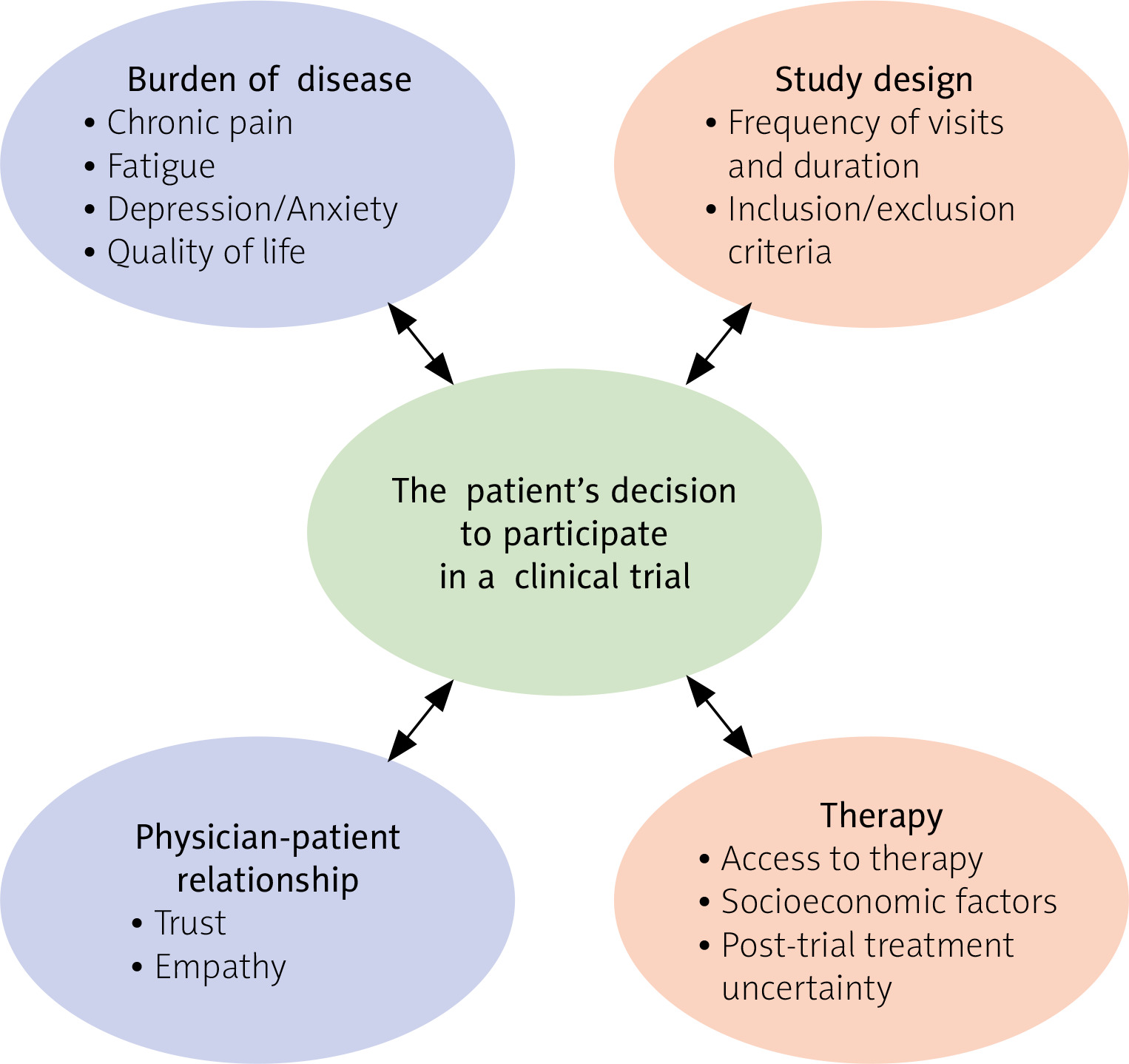
A useful starting point is to consider patients’ motivations for enrolling in clinical trials, as these motivations often reflect the benefits that patients perceive. For many patients, participation is driven by the awareness that clinical trials are necessary for progress in medicine [19]. In a sense, this is altruistic behaviour, which is important from the patient’s perspective [20]. A key role is played by the patient’s hope that the study may truly contribute to progress in treating their disease. For some, this alleviates feelings of guilt that participation stems from self-interest – taking care of their own health [19]. In self-oriented motivation, important factors include easier access to treatment, the hope for more effective therapy, and avoiding the risk of increasing disability.
Another factor directly influencing a patient’s decision is the clinician’s attitude. Regardless of the patient’s motivation, it is usually the treating physician who presents the possibility of participating in a clinical trial. At this stage, it is crucial not only to convey information clearly, but also to build trust between doctor and patient [21]. Important traits include empathy, the ability to listen, building trust, and motivating the patient. This is especially important for patients dealing with chronic pain [21]. In rheumatology, this is particularly relevant because most patients experience chronic pain and must cope with its daily consequences.
Ultimately, although patient motivation is crucial, without the involvement of the treating physician, it is difficult to expect the patient to participate. This dependence shows how demanding the recruitment process can be when human factors are considered. Focusing only on the study protocol is insufficient. In addition to educating patients, clinicians also need education to provide reliable information to patients about their role in a clinical trial before participation.
Patient motivations and engagement in clinical trials are well described in the literature [20, 21]. Nevertheless, the course of the disease may significantly influence them. Patients with mild symptoms and no noticeable decline in quality of life are often not interested in participating [20]. Consequently, patients with more severe symptoms may constitute a larger candidate pool. Here, it is important to return to the role of pain in inflammatory diseases and its influence on patient lives.
Unfortunately, chronic pain may also cause patients to feel ambivalent about participating despite severe symptoms [20]. This disrupts the previously described doctor-patient dynamic. Pain in rheumatic diseases is associated with chronic fatigue, insomnia, depression, increased anxiety, and greater disability [22–24]. These factors significantly influence patients’ decisions, including treatment choices [20].
These relationships are reflected in studies analysing the motivations of patients with rheumatic diseases to participate in clinical trials, particularly in populations with RA and systemic lupus erythematosus (SLE). Altruism is one of the main reasons for the participation of patients with RA and SLE in clinical trials [25]. Patients with SLE constitute a special group due to the nature and course of the disease. In addition to altruistic motivations, an equally important factor encouraging participation in clinical trials is the opportunity to gain access to modern therapies. On the other hand, alongside altruism and the desire to improve their own health, patients often express concerns about the potential complications of new therapies, which negatively affects their willingness to participate in trials [25].
Another extremely interesting aspect of clinical trials in the context of rheumatic diseases is the higher placebo response rate observed in less affluent areas [26]. The reasons for this phenomenon are not fully understood; 1 potential mechanism may be limited access to healthcare. However, the occurrence of an increased placebo effect can significantly affect sample size calculation, leading to the need to increase the number of participants and thus prolong the duration of the clinical trial.
Recruitment problems
A fundamental limitation in patient recruitment is the lack of information about ongoing clinical trials. Patients often do not know that a study is being conducted in which they could potentially participate. In this case, the best strategy would be to reach as many primary care physicians and specialists as possible and convince them that participation in a clinical trial could benefit their patients.
A major current limitation is the lack of trust in pharmaceutical companies, especially regarding vaccine trials [27]. Some patients suspect they are being treated like “guinea pigs” and believe the main beneficiaries are sponsors, contract research organization (CROs), and investigators. In rheumatology, this issue may be less severe because patients are often treated by the same doctors for many years, which helps build trust. However, many myths about biological drugs circulate [28], which may lead patients to fear participating in trials.
Ultimately, this brings us back to the earlier issue – the doctor-patient relationship. The most important element is conversation, during which the clinician must provide clear and comprehensive answers to patient questions and concerns, explaining the trial in an accessible manner. Any unanswered concerns may affect the patient’s willingness to participate [27]. It is worth emphasizing that refusal to participate not only negatively affects recruitment but may also influence the patient’s treatment. Patients who completed clinical trials report that participation offers high-quality healthcare, helps them better understand their disease, and increases social activity by engaging with other patients [20].
Given these considerations, an effective recruitment strategy may be for the treating physician – whom the patient trusts – to propose participation [19]. Patients often report that being disconnected from the doctors and staff they know is problematic. Therefore, clinical trials must maintain continuity in patient care, so patients are not completely removed from their previous medical environment. This is particularly important for patients with rheumatic diseases, who typically have long-term relationships with their physicians and clinic staff. Removing them from this familiar environment may create a significant barrier to trial participation. Thus, it is important to ensure professional communication with primary care doctors and specialists previously involved in the patient’s treatment, informing them about the patient’s participation in a clinical trial.
Ferguson et al. [19] note that 1 recruitment limitation may be the uncertainty around post-trial treatment, especially when continued therapy involves cost. Another major limitation is the distance between the patient’s home and the trial centre. For working patients, long and frequent visits are also a considerable challenge [19].
Simplifying trials
The number and length of visits represent a serious problem – patients often report this during trials. Changing protocols to make them more flexible could indeed improve recruitment rates. Unfortunately, how exactly protocols should be changed is not obvious. Patients with chronic pain often prefer longer visits, while patients with two or more chronic conditions believe visits should be shorter [29]. This example illustrates the complexity of preparing an appropriate protocol. The disease itself may significantly influence these preferences, making it difficult to apply conclusions from 1 field, such as oncology, to rheumatology due to differing disease characteristics and patient challenges.
Currently, survey studies are being conducted on how patients believe trial visits should look. For rheumatology, important studies involve patients with chronic illness and chronic pain [30, 31]. A characteristic feature in both groups was the preference for hybrid visits – some remote and some in-person. Considering the experience gained during the COVID-19 pandemic, most centres now have the capacity to conduct remote visits. This is a change that could realistically be incorporated into protocols, increasing trial accessibility. Patients with chronic pain also stress that participation should not exacerbate pain. This group is especially focused on keeping pain at the lowest possible level [30].
Simplifying protocols and optimizing visit times are extremely important. Patients with chronic diseases must also have time for work and social activity. Without this, they may feel ambivalent about therapy, as reduced professional and social activity may contribute to depression, significantly complicating treatment of the underlying condition.
To conclude the discussion on simplifying clinical trials, it is also worth referring to the updated Declaration of Helsinki of 2024 [32]. This document emphasizes that clinical trials should be designed and conducted with consideration for the principles of sustainable development and minimization of burdens, including the environmental impact. At the same time, the declaration clearly states that the responsibility for protecting trial participants always rests with physicians and researchers, and not with the participants themselves, even if they have given their informed consent to participate in the trial. It also draws attention to the need to ensure adequate access to clinical trials for underrepresented groups, which is crucial from the point of view of ethics, quality, and the reliability of the results obtained.
Feedback – plain language summary
The discussion of difficulties in recruiting patients for clinical trials began with addressing patient motivation for participating in clinical trials. One of the more important motivations turned out to be the desire to contribute to medical progress – patients are aware that without clinical trials, progress is not possible [19]. In this context, patients may naturally be interested in the trial results, i.e., not only in improving their own health but also in the global effectiveness of the therapy. Unfortunately, access to trial results is limited. Very often, they are published in prestigious medical journals. The nature of such publications is purely scientific – they are characterized by highly specialized language as well as advanced statistical tools, which may be difficult to understand even for clinicians [33]. The potential for statistical analyses to influence the interpretation of clinical trial results is illustrated by the example of the VIGOR trial, in which patients with RA participated [34]. It compared rofecoxib and naproxen, and only later was it revealed that the statistical tools used “masked” the adverse effects of rofecoxib [34, 35]. The VIGOR study highlighted two issues. Studies like this cause patients to have concerns regarding research ethics. This shows that the previously discussed problem of patient trust in clinicians has real significance. The second issue is the need to present trial results in a simple manner if they are to be accessible to patients. Even experienced clinicians, including editors and reviewers, are not always able to correctly interpret trial results [34, 35].
For this reason, plain-language summaries (PLS) are so important – they present trial results in such a way that even individuals who are not medical professionals can easily understand them [36]. The difference between a strictly scientific paper and a PLS is clearly visible in the discussion of the ROSALIA study [37, 38]. Both works discuss the same results, but the accessibility of the content is entirely different. PLS can indeed satisfy patients’ scientific curiosity regarding clinical trial results. In this case, since one of the motivations is scientific progress, the ability to review the trial results can be an additional motivation to participate in a clinical trial. It provides the patient with a unique opportunity for full engagement in the clinical trial, serving in a way as a reward for their participation.
Conclusions
Clinical trials contribute not only to progress in medicine but also to increased patient access to treatment. Unfortunately, clinical trials also involve a range of challenges, among which patient recruitment is one of the most important. Trials are designed to assess both the effectiveness of the therapy and its safety profile as accurately as possible. Nevertheless, patient perspectives and experiences have not always been adequately incorporated into trial design. Recruitment difficulties continue to limit the successful completion of many trials. Therefore, a more patient-centred approach to clinical trial design is required, taking into account patients’ needs and motivations, as well as the accessibility and transparency of the clinical trial.